Competitive Hotel Market Intelligence for New Market Entry and Competitor Analysis
Introduction
Entering a new hotel market requires more than analyzing tourism reports or basic demand statistics. Hotel operators, investors, and hospitality brands need accurate visibility into competitor positioning, pricing behavior, room availability, guest preferences, and market gaps before making expansion decisions. Competitive hotel market intelligence enables businesses to evaluate existing hotels, identify revenue opportunities, and understand how competitors operate within a specific destination.
Modern hospitality businesses rely on data-driven approaches to reduce uncertainty when entering new regions. By collecting information from hotel booking platforms, competitor websites, review portals, and travel marketplaces, companies can build a detailed understanding of local market dynamics. Hotel Data Intelligence helps transform large volumes of hotel information into actionable insights related to pricing, demand, customer behavior, and operational strategies.
With increasing competition among hotels, resorts, and alternative accommodations, brands are adopting competitive hotel analytics to compare their performance against similar properties. Scraped datasets allow businesses to track room rates, promotions, occupancy indicators, ratings, amenities, and customer sentiment. This information supports smarter investment decisions, better positioning strategies, and stronger market entry plans.
Role of Hotel Data Scraping in Market Assessment
Hotel Data Scraping has become a valuable technique for gathering structured information from multiple online sources. A hotel entering a new market can collect competitor data from online travel agencies (OTAs), hotel websites, and accommodation platforms to understand the competitive landscape.
The collected information generally includes:
- Hotel name and location
- Room categories
- Available room types
- Nightly prices
- Discounts and promotional offers
- Cancellation policies
- Guest ratings
- Customer reviews
- Amenities
- Availability patterns
- Seasonal pricing changes
This data helps create a comprehensive market overview. Instead of depending on limited public reports, businesses can continuously monitor competitors and detect market movements.
A new hotel brand can analyze whether existing properties focus on luxury travelers, business guests, budget tourists, or family customers. It can also identify underserved customer segments where new offerings may gain traction.
Understanding Existing Hotels Through Competitor Analysis
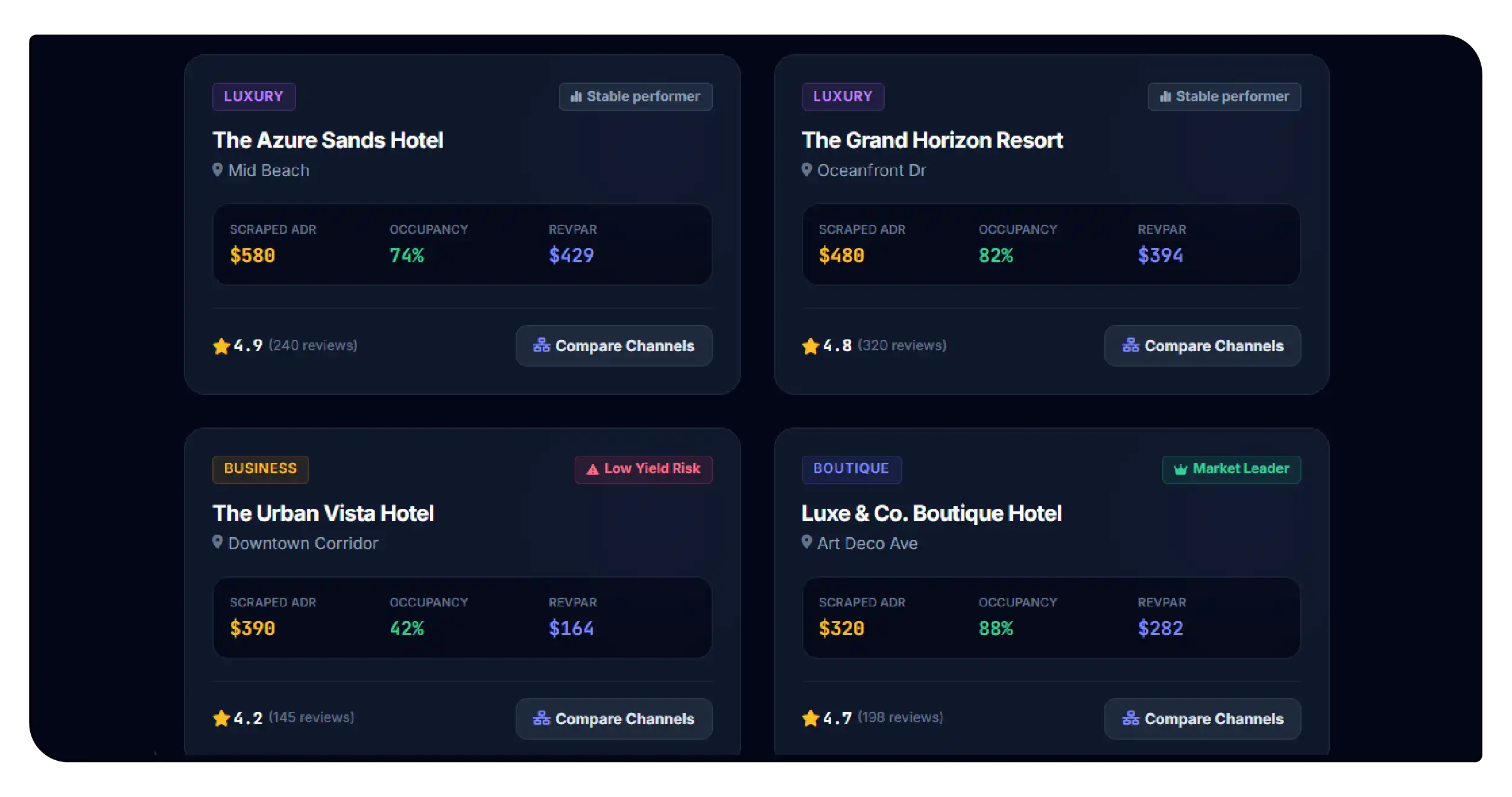
Before launching a property, hotel operators need to understand who they are competing against. Competitor analysis involves studying hotels with similar characteristics, such as location, room inventory, target audience, and service category.
For example, a new four-star hotel entering a city center market may compare itself with:
- Similar star-rated hotels
- Nearby boutique properties
- International hotel chains
- Popular independent accommodations
- High-performing properties on booking platforms
The objective is not only to compare prices but also to understand the complete competitive environment.
Important competitor factors include:
1. Pricing Strategy Analysis
Hotel prices change frequently based on seasonality, demand, events, and competitor movements. Scraped pricing data helps identify:
- Average daily rates
- Weekend versus weekday pricing
- Seasonal pricing patterns
- Last-minute discounts
- Premium pricing periods
A hotel can determine whether competitors increase rates during high-demand periods or use aggressive discounts to maintain occupancy.
2. Room Availability Monitoring
Availability patterns indicate demand strength. If competitors frequently show limited inventory, it may suggest strong demand conditions.
Hotels can track:
- Available rooms
- Sold-out dates
- Room category availability
- Booking windows
This helps businesses estimate demand levels before entering the market.
3. Customer Review and Reputation Analysis
Reviews provide competitor hotel performance insights into guest expectations and competitor weaknesses.
Hotels can analyze:
- Common complaints
- Frequently praised services
- Staff performance
- Cleanliness ratings
- Location satisfaction
This enables new entrants to design better guest experiences.
Competitor Hotel Market Dataset Example
| Hotel Name | Category | Location Type | Average Room Rate ($) | Average Rating | Rooms Available | Main Customer Segment | Monthly Demand Index | Promotional Activity |
|---|---|---|---|---|---|---|---|---|
| Hotel Alpha | Luxury | City Center | 280 | 4.7 | 18 | Business & Premium Travelers | 92 | Low Discounting |
| Hotel Beta | Upscale | Business District | 220 | 4.5 | 25 | Corporate Guests | 85 | Seasonal Offers |
| Hotel Gamma | Midscale | Tourist Area | 140 | 4.2 | 40 | Leisure Travelers | 76 | Frequent Promotions |
| Hotel Delta | Budget | Central Location | 90 | 3.9 | 60 | Budget Travelers | 68 | High Discounting |
| Hotel Epsilon | Boutique | Heritage Area | 190 | 4.6 | 15 | Experience Seekers | 81 | Package Deals |
| Hotel Zeta | Upscale | Airport Zone | 170 | 4.3 | 32 | Transit & Business | 73 | Corporate Rates |
Key Observation:
The table indicates that luxury and boutique hotels maintain stronger ratings with higher pricing power, while budget hotels depend more on discounts and larger inventory. A new entrant can identify opportunities by targeting segments with high demand but limited premium offerings.
Building a Hotel Rate Comparison Dataset
A structured pricing database helps businesses understand how competitors position themselves. A hotel rate comparison dataset allows brands to compare rates across multiple dates, room types, and booking channels.
This dataset supports:
- Price benchmarking
- Revenue optimization
- Promotion analysis
- Rate parity monitoring
- Competitor response tracking
Hotels can identify whether competitors follow fixed pricing models or dynamic pricing strategies.
For example, if a competitor increases room prices by 35% during festivals or business events, a new hotel can prepare similar pricing strategies.
Using Competitor Benchmarking for Strategic Decisions
Competitor Benchmarking enables hotels to measure their performance against market leaders. Benchmarking focuses on comparing important metrics such as:
- Average room rate
- Customer rating
- Availability
- Booking trends
- Market positioning
- Service quality
This helps identify where a hotel stands within the market.
A property may discover that competitors have stronger brand recognition but weaker customer satisfaction. This creates an opportunity to compete through better service quality.
Hotel Competitive Performance Analysis Dataset
| Metric | Hotel Alpha | Hotel Beta | Hotel Gamma | Hotel Delta | Market Average |
|---|---|---|---|---|---|
| Average Daily Rate ($) | 280 | 220 | 140 | 90 | 182 |
| Occupancy Estimate (%) | 88 | 82 | 74 | 65 | 77 |
| Customer Rating | 4.7 | 4.5 | 4.2 | 3.9 | 4.3 |
| Review Volume | 2450 | 3100 | 4200 | 5600 | 3840 |
| Weekend Price Increase (%) | 30 | 22 | 15 | 8 | 19 |
| Cancellation Flexibility | Medium | High | High | High | — |
| Loyalty Program Strength | Strong | Medium | Low | None | — |
| Online Visibility Score | 95 | 88 | 80 | 72 | 84 |
Key Observation:
The data shows that premium hotels achieve stronger revenue performance through higher rates and customer satisfaction. Budget hotels attract larger review volumes but have lower pricing power. A new property can use these insights to define its pricing, branding, and service strategy.
Predicting Market Opportunities Using Scraped Data
Historical hotel data helps businesses identify future market trends. By analyzing past pricing movements, availability changes, and demand patterns, hotels can predict future performance.
Hotel booking trend forecasting helps estimate:
- Peak booking periods
- Low-demand seasons
- Customer booking behavior
- Future pricing opportunities
For example, if scraped data shows increasing demand during business conferences, a hotel can adjust inventory and pricing strategies accordingly.
Demand forecasting also helps determine whether a market has enough capacity for a new hotel. If existing hotels consistently operate at high occupancy, new investment opportunities may exist.
Tracking Competitor Pricing Movements
Competitor Price Tracking provides continuous monitoring of competitor rates across booking channels.
Hotels can identify:
- Sudden price reductions
- Flash promotions
- Seasonal campaigns
- Weekend adjustments
- Competitor pricing strategies
This enables revenue teams to respond quickly instead of relying on outdated market reports.
A hotel launching in a new market can use pricing intelligence to avoid entering with unrealistic rates. It can position itself competitively from the beginning.
Measuring Market Position and Demand
Scraped hotel data also supports market segmentation. Businesses can analyze which hotels dominate specific customer groups.
Examples:
- Luxury travelers → premium hotels
- Business travelers → city and airport hotels
- Families → resort-style properties
- Budget travelers → economy accommodations
Understanding customer distribution helps investors decide the type of hotel concept that has the highest probability of success.
Challenges in Using Scraped Hotel Data
Although data-driven analysis provides significant advantages, businesses must manage several challenges:
Data Accuracy
Hotel prices and availability change frequently. Regular data collection is required to maintain accurate insights.
Data Standardization
Different platforms display information differently. Data needs cleaning and normalization before analysis.
Market Complexity
Hotels compete based on multiple factors, including location, reputation, amenities, and customer experience.
Compliance Considerations
Data collection should follow platform policies and responsible data usage practices.
Future of Hotel Market Intelligence
The hospitality industry is moving toward automated intelligence systems that combine scraped data with analytics and artificial intelligence. Future hotel strategies will depend on real-time insights rather than traditional market research.
Advanced systems will help hotels:
- Monitor competitors automatically
- Predict demand changes
- Optimize pricing
- Identify customer preferences
- Improve revenue decisions
Hotels entering new markets will increasingly depend on data-driven intelligence to reduce investment risks.
Conclusion
Assessing existing hotels in a new market requires accurate competitor visibility, pricing analysis, and demand understanding. Through hotel demand data monitoring, businesses can continuously evaluate market conditions and identify opportunities. Competitive hotel pricing data scraping provides valuable information about competitor rates, promotions, and pricing strategies.
By combining scraped datasets with analytics, hotels can perform effective Market Share Analysis and understand where they can compete successfully. Data-driven hotel intelligence allows investors and operators to make informed decisions, optimize positioning, and create strategies that match real market conditions.
Ready to elevate your travel business with cutting-edge data insights? Scrape Aggregated Flight Fares to identify competitive rates and optimize your revenue strategies efficiently. Discover emerging opportunities with tools to Extract Travel Website Data, leveraging comprehensive data to forecast market shifts and enhance your service offerings. Real-Time Travel App Data Scraping Services helps stay ahead of competitors, gaining instant insights into bookings, promotions, and customer behavior across multiple platforms. Get in touch with Travel Scrape today to explore how our end-to-end data solutions can uncover new revenue streams, enhance your offerings, and strengthen your competitive edge in the travel market.
Unlock the Full Report
Enter your details to access premium pricing intelligence insights