Bus Schedule & Fare Scraping in India: Extracting Data from State Transport and Private Operators
Introduction
India's bus transport ecosystem is one of the most complex and fast-moving mobility networks in the world. With thousands of state transport services and private operators running across intercity and intracity routes, keeping track of schedules and fares manually is nearly impossible. This has created a strong demand for automated systems that can continuously collect, structure, and analyze transport data to support smarter decision-making.
Modern mobility platforms, travel aggregators, logistics companies, and analytics firms are increasingly relying on structured data pipelines to understand how bus networks operate in real time. This shift is redefining how travel intelligence is built and consumed in India.
At the core of this transformation is Bus Schedule & Fare Scraping in India, which enables continuous extraction of route details, departure timings, seat availability, and fare variations from multiple sources such as booking platforms and operator websites. This process helps convert scattered transport information into structured, usable intelligence.
Alongside this, Bus Data Scraping plays a crucial role in aggregating large volumes of transport-related information from fragmented sources. Since bus operators use different digital systems, scraping helps unify this data into a single analytical framework.
Another key aspect is India bus fare data extraction, which allows businesses to track fare fluctuations across seasons, demand surges, weekends, and festival periods. This is especially important in India, where pricing is highly dynamic and influenced by multiple external factors.
Building Structured Transport Intelligence from Fragmented Data
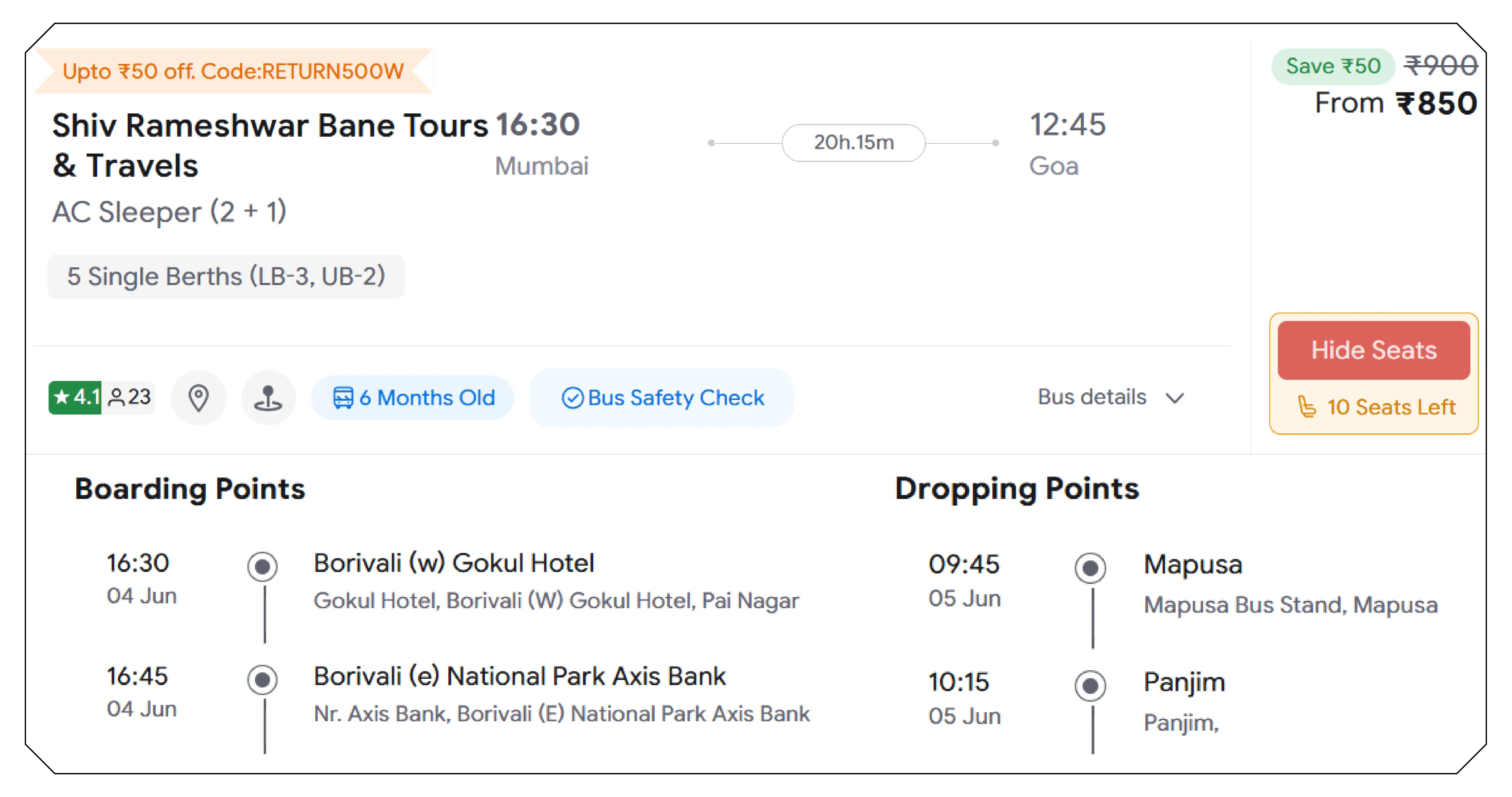
India's bus ecosystem lacks a universal standardized database. State transport corporations, private operators, and aggregator platforms all maintain separate systems with different formats and update cycles. This makes it difficult to build a unified view without structured data engineering.
A well-organized Scheduled Dataset helps solve this problem by consolidating departure timings, arrival schedules, route frequency, and operational status into a standardized format. This enables better comparison, forecasting, and route optimization.
When such datasets are enriched with historical and real-time inputs, they become powerful tools for mobility intelligence platforms that support both travelers and businesses.
Public and Private Sector Intelligence Applications
Different stakeholders in the bus ecosystem use data in different ways. Government bodies focus on improving coverage and efficiency, while private operators focus on maximizing occupancy and revenue.
For example, state transport bus schedule intelligence India is used by public transport authorities to improve fleet utilization, reduce delays, and ensure better service availability in underserved regions. It helps governments identify inefficiencies and optimize route planning.
On the other hand, private bus operator pricing analytics India is used by private companies to analyze demand patterns, competitor pricing, and booking trends. This allows operators to adjust fares strategically and improve profitability while maintaining competitiveness.
Dynamic Pricing and Fare Optimization in Bus Industry
One of the biggest transformations in the Indian bus sector is the adoption of real-time pricing models. Unlike traditional fixed pricing systems, modern operators adjust fares dynamically based on demand, occupancy, and travel season.
This evolution is driven by Dynamic Pricing Intelligence, which uses historical trends and real-time signals to recommend optimal pricing strategies. It helps operators balance seat occupancy with revenue optimization, especially on high-demand routes.
At the same time, continuous tracking systems support India bus timetable and fare monitoring, ensuring that both users and platforms always have access to updated information about departures and pricing changes. This improves transparency and reduces last-minute booking uncertainty.
Real-Time Alerts and Predictive Monitoring Systems
As competition increases in the travel industry, real-time monitoring has become essential. Platforms now track fare movements and schedule changes continuously to provide instant updates to users and internal systems.
One of the most useful applications is Fare Fluctuation Alerts, which notify users when ticket prices increase or decrease significantly. This helps travelers make cost-effective booking decisions and improves user experience on travel platforms.
These systems are also used to detect anomalies such as sudden cancellations, route delays, or unexpected price spikes, allowing businesses to respond proactively.
Expanding Use Cases Across Industries
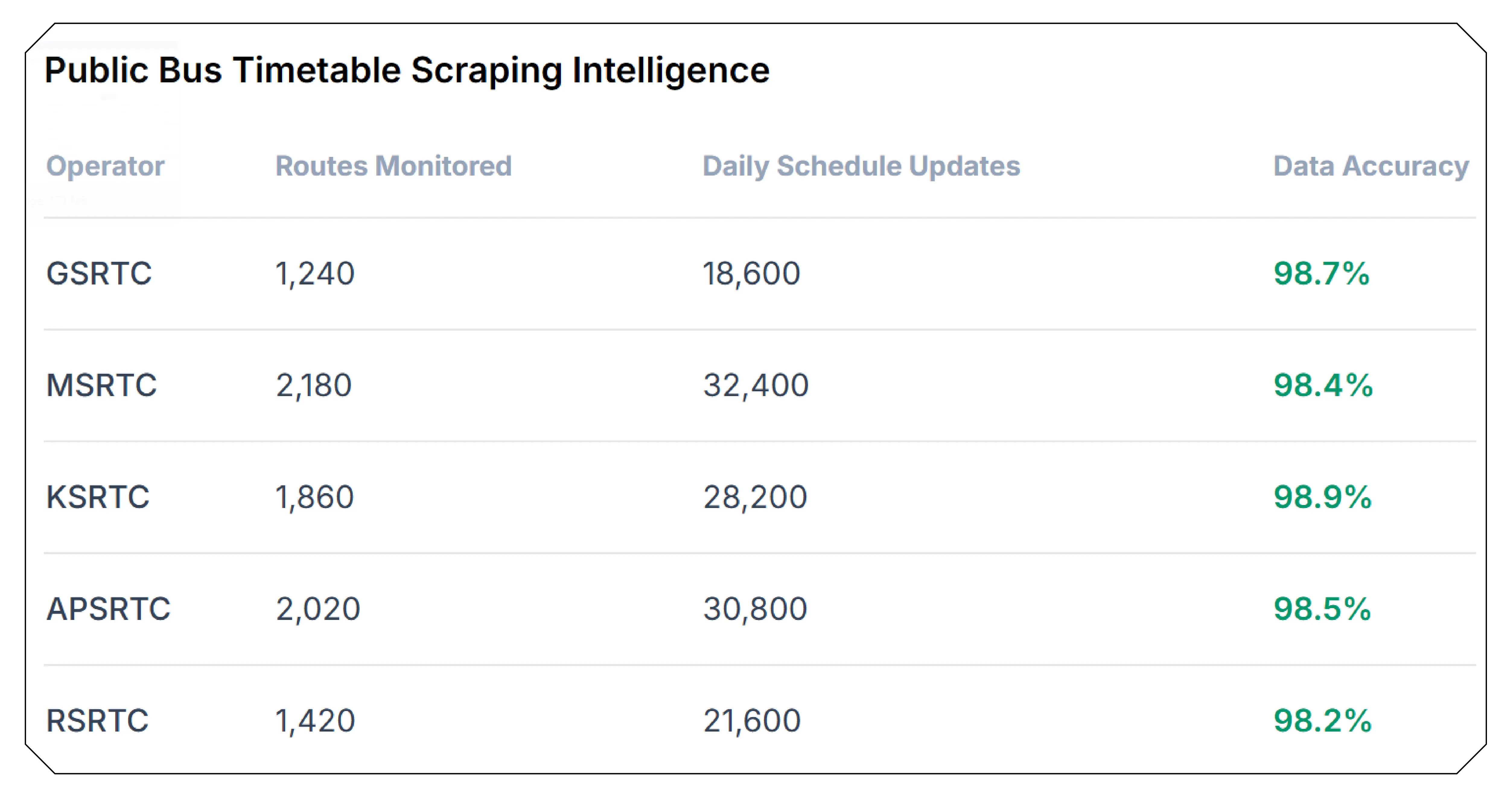
Bus schedule and fare data is no longer limited to travel booking platforms. It is now widely used across logistics, tourism, financial forecasting, and urban mobility planning.
Logistics companies use this data to optimize cargo movement across cities. Tourism platforms use it to design travel packages based on connectivity and affordability. Even insurance and fintech companies use transport data to assess regional mobility patterns and economic activity.
In this context, public Bus transport timetable data scraping becomes essential for building accurate, real-time datasets that reflect actual service availability across government and private networks.
Similarly, the strategy to scrape intercity bus schedule data India enables platforms to understand long-distance travel demand, identify high-traffic corridors, and optimize intercity route planning for better efficiency and coverage.
Challenges in Bus Data Extraction
Despite its benefits, extracting bus data at scale comes with several challenges. Websites often change layouts frequently, APIs are not standardized, and data formats vary widely across operators. Additionally, real-time accuracy is difficult to maintain due to frequent schedule updates.
To overcome these challenges, modern systems use adaptive scraping frameworks, AI-based parsing models, and validation engines that clean and normalize data continuously. These technologies ensure that even unstructured or inconsistent data can be converted into reliable datasets.
Business Value of Bus Data Intelligence
Organizations that invest in bus data intelligence gain a significant competitive advantage. They can forecast demand more accurately, optimize pricing strategies, and improve customer satisfaction through better transparency.
Real-time analytics also help in identifying underserved routes, peak travel periods, and regional demand patterns. This enables better strategic planning for expansion and resource allocation.
In addition, continuous Price Monitoring helps businesses stay competitive by tracking fare changes across multiple operators and adjusting strategies accordingly. It ensures that platforms remain updated with market fluctuations and can respond quickly to pricing shifts.
Future of Bus Mobility Intelligence in India
The future of bus data systems in India is expected to be driven by automation, predictive analytics, and AI-powered decision-making. As more operators digitize their systems, the availability of structured data will increase significantly.
We will likely see integrated mobility platforms that combine buses, trains, ride-hailing, and micro-mobility into unified travel ecosystems. Predictive pricing, real-time seat optimization, and demand forecasting will become standard features across travel platforms.
How Travel Scrape Can Help You?
1. Real-Time Market Intelligence for Better Decisions
Our data scraping services continuously collect updated transport schedules, fares, and route changes, helping you make faster, data-driven decisions with real-time visibility into market fluctuations and travel demand patterns.
2. Accurate Fare Benchmarking and Competitive Analysis
We help you compare pricing across multiple bus operators by extracting structured fare datasets, enabling precise benchmarking, competitive positioning, and identification of pricing gaps across routes and seasonal travel periods.
3. Dynamic Pricing Optimization Support
By delivering structured historical and real-time fare data, our services power dynamic pricing models that help optimize ticket prices based on demand, occupancy trends, route popularity, and seasonal travel surges.
4. Improved Operational Efficiency and Planning
Our scraping solutions provide clean scheduled datasets that support route planning, fleet allocation, and capacity forecasting, reducing inefficiencies and improving operational decision-making for transport and mobility businesses.
5. Scalable Data Infrastructure for Analytics Systems
We build scalable data pipelines that extract, clean, and structure large volumes of transport data, ensuring seamless integration with dashboards, APIs, and analytics platforms for long-term business intelligence growth.
Conclusion
Bus transportation in India is undergoing a major digital transformation, and data is at the center of this evolution. From scheduling efficiency to fare optimization, structured intelligence is reshaping how the entire ecosystem operates.
With advanced data extraction techniques, businesses can now build powerful insights that improve planning, pricing, and customer experience. As adoption grows, bus data intelligence will become a foundational layer for the future of mobility in India.
Ready to elevate your travel business with cutting-edge data insights? Scrape Aggregated Flight Fares to identify competitive rates and optimize your revenue strategies efficiently. Discover emerging opportunities with tools to Extract Travel Website Data, leveraging comprehensive data to forecast market shifts and enhance your service offerings. Real-Time Travel App Data Scraping Services helps stay ahead of competitors, gaining instant insights into bookings, promotions, and customer behavior across multiple platforms. Get in touch with Travel Scrape today to explore how our end-to-end data solutions can uncover new revenue streams, enhance your offerings, and strengthen your competitive edge in the travel market.
Unlock the Full Report
Enter your details to access premium pricing intelligence insights