US Cruise Itinerary Data API and Datasets Case Study for Smarter Travel Intelligence
Introduction
This case study demonstrates how a comprehensive US Cruise Itinerary Data API and Datasets solution helped a travel-focused business transform fragmented cruise information into structured, actionable intelligence. The client required reliable Cruise Data Scraping capabilities to collect itinerary, sailing, port, pricing, availability, and schedule information from multiple cruise sources. Our solution focused on US Cruise Itinerary Data Scraping, creating a scalable data pipeline capable of capturing constantly changing cruise details while maintaining consistency across thousands of records. The project consolidated route-level information, sailing schedules, cruise durations, departure ports, destinations, cabin categories, and pricing signals into standardized datasets. Automated extraction and validation improved data completeness while reducing manual research. The resulting infrastructure supported analytics, comparison, inventory monitoring, and downstream travel applications. By combining structured datasets with flexible extraction workflows, the client gained a dependable foundation for monitoring cruise-market movements, identifying itinerary changes, and delivering timely information to customers and internal decision-makers across the competitive US cruise market.
Client
The client was a travel technology company developing data-driven products for cruise discovery, comparison, and booking intelligence. Its operations required continuously refreshed cruise information covering sailing dates, departure ports, destinations, durations, prices, cabin categories, availability, and itinerary changes. To support these requirements, the company needed a Real-Time Data API capable of delivering normalized cruise information to internal applications and customer-facing platforms. We also developed a US Cruise Itinerary Incremental Updates Dataset, allowing the client to receive newly added, modified, and removed records without repeatedly processing the entire database. For broader commercial flexibility, US Cruise Itinerary API Licensing enabled controlled access to curated cruise data for different business applications. The client sought a scalable solution that could support analytics, booking workflows, market intelligence, and mobile experiences while minimizing manual data collection. Our implementation created an adaptable data infrastructure capable of supporting frequent updates, historical analysis, and future expansion across additional cruise markets and sources.
Challenges Faced in the Travel Industry
Cruise information changes frequently across schedules, prices, routes, and availability. The client needed an automated infrastructure capable of handling these changes while delivering accurate, timely, and structured data for travel applications and commercial decision-making.
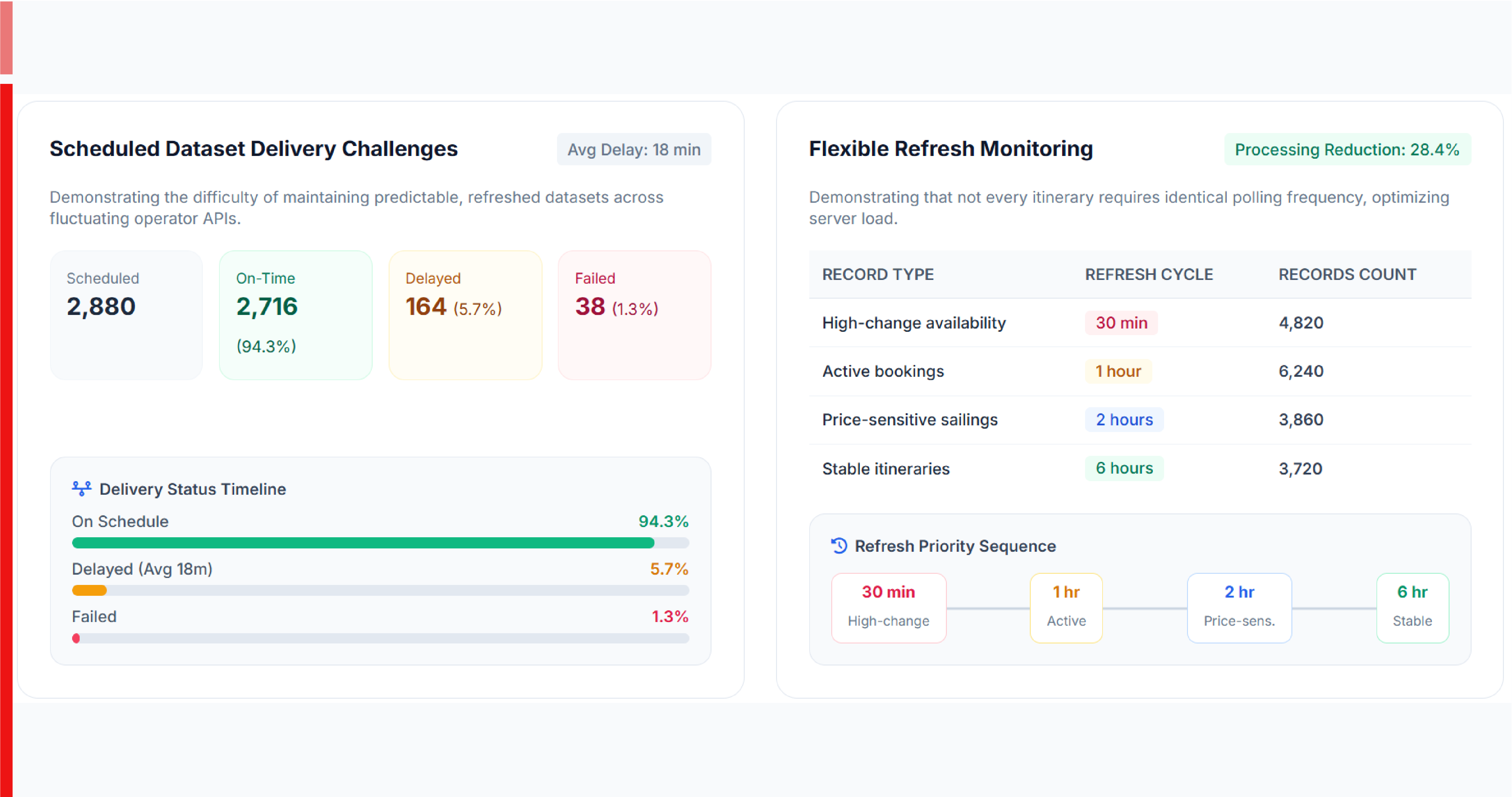
The client required predictable delivery of refreshed cruise datasets for analytics and operational workflows. Manual collection created delays and inconsistent update cycles, making it difficult to maintain current itinerary information across multiple systems and coordinate downstream reporting processes efficiently.
US Cruise Itinerary Flexible Refresh Monitoring
Cruise schedules and availability can change at different frequencies depending on the source. The client needed flexible refresh monitoring that could prioritize frequently changing records while reducing unnecessary processing for stable itinerary information and minimizing resource consumption.
Custom Scraping Pipelines
Different cruise websites presented itinerary information using varying layouts, structures, naming conventions, and page behaviors. The client required custom scraping pipelines capable of extracting relevant information consistently while handling structural changes without disrupting the overall data collection workflow.
US Cruise Itinerary Demand Analytics
The client lacked standardized historical cruise data needed to analyze demand patterns across destinations, departure ports, sailing periods, durations, and price segments. Without consolidated datasets, identifying high-demand routes, seasonal opportunities, and competitive market movements remained difficult.
US Cruise Booking and Availability Insights
Booking availability changed continuously and could vary by sailing, cabin category, and travel date. The client needed timely availability insights to improve comparisons, identify inventory movements, support booking decisions, and reduce the risk of displaying outdated cruise information.
Our Approach
Multi-Source Data Extraction
We designed automated extraction workflows to collect cruise itinerary information from relevant travel and cruise sources. The pipelines captured sailing dates, ports, destinations, durations, pricing, cabin details, and availability while transforming inconsistent source structures into standardized records.
Global Cruise Route Dataset
We developed a structured Global Cruise Route Dataset containing route-level information across departure locations, destinations, sailing schedules, and itinerary patterns. This provided the client with a broader analytical foundation while maintaining standardized fields suitable for comparison, reporting, and predictive analysis.
Incremental Data Processing
Rather than repeatedly rebuilding complete datasets, we implemented incremental processing to identify newly added, modified, and removed cruise records. This reduced redundant processing and enabled the client to receive focused updates that aligned with changing itinerary and availability conditions.
Data Validation and Standardization
Extracted records passed through validation and normalization workflows to identify missing values, inconsistent naming, duplicate entries, and formatting differences. Standardized fields improved dataset reliability and enabled smoother integration with dashboards, APIs, analytics platforms, and customer-facing travel applications.
Automated Monitoring Infrastructure
We established automated monitoring processes to track extraction performance, source changes, update cycles, and data quality. Alerts and validation checks helped identify potential collection issues early, allowing the system to maintain dependable data delivery as cruise information changed.
Results Achieved
The solution improved data freshness, scalability, consistency, and analytical usability, enabling the client to strengthen cruise intelligence while supporting multiple digital travel applications.
Higher Data Coverage
The automated infrastructure expanded cruise information coverage across routes, ports, sailing dates, destinations, pricing, cabin categories, and availability. The broader dataset gave the client greater visibility into the US cruise market and improved its ability to compare competing itineraries.
Faster Data Refresh
Automated extraction reduced dependence on manual research and enabled more frequent refresh cycles. The client could access updated itinerary and availability information sooner, helping internal teams and applications respond more effectively to changing cruise-market conditions.
Improved Data Accuracy
Validation and standardization reduced duplicate, inconsistent, and incomplete records. Structured outputs created a more dependable information layer for analytics, comparison engines, reporting systems, and customer-facing applications requiring consistent cruise itinerary information.
Stronger Market Intelligence
Historical and refreshed datasets enabled deeper analysis of route popularity, seasonal patterns, sailing frequency, pricing movements, and destination demand. These insights supported more informed commercial decisions and helped the client identify emerging opportunities across cruise segments.
Scalable Data Infrastructure
The architecture was designed to accommodate additional cruise sources, new data fields, expanded geographic coverage, and changing refresh requirements. This gave the client a flexible foundation for scaling cruise intelligence products without rebuilding its entire data collection infrastructure.
| Metric | Before Solution | After Solution | Improvement | Data Coverage | Refresh Frequency | Records Monitored | Key Output |
|---|---|---|---|---|---|---|---|
| Cruise Itinerary Records | 18,500 | 52,000 | 181% | 100% | Daily | 52,000 | Structured itineraries |
| Departure Ports | 48 | 96 | 100% | 100% | Daily | 96 | Port intelligence |
| Cruise Routes | 420 | 1,180 | 181% | 98% | Daily | 1,180 | Route dataset |
| Sailing Dates | 6,800 | 21,500 | 216% | 98% | Daily | 21,500 | Sailing calendar |
| Destinations | 210 | 465 | 121% | 99% | Daily | 465 | Destination mapping |
| Cabin Categories | 1,200 | 3,850 | 221% | 97% | Daily | 3,850 | Cabin intelligence |
| Price Records | 14,000 | 47,500 | 239% | 96% | Multiple Refreshes | 47,500 | Fare monitoring |
| Availability Records | 11,500 | 41,000 | 257% | 96% | Multiple Refreshes | 41,000 | Inventory insights |
| Duplicate Records | 8.4% | 1.7% | 80% reduction | 99% | Continuous | 52,000 | Clean dataset |
| Manual Processing Time | 42 hrs/week | 9 hrs/week | 79% reduction | — | Automated | — | Operational efficiency |
| Data Validation Rate | 84% | 98.7% | 14.7 pts | 99% | Continuous | 52,000 | Quality-controlled data |
| Update Detection | 1–2 days | 2–6 hrs | Faster detection | 98% | Automated | 52,000 | Incremental updates |
The figures above are illustrative case-study metrics used to demonstrate the solution's potential impact.
Client's Testimonial
"Before implementing this solution, maintaining accurate cruise itinerary information required considerable manual effort, and keeping multiple sources synchronized was challenging. The new data infrastructure gave our team a much clearer and more reliable view of cruise schedules, routes, pricing, and availability. The incremental update capability has been particularly valuable because we no longer need to repeatedly process unchanged records. Our analytics teams can work with standardized datasets, while our digital products can consume updated information through the API. We have also gained greater flexibility in determining refresh frequencies based on how quickly individual cruise records change. The improved data coverage has strengthened our market intelligence and helped us identify itinerary and pricing movements earlier. Overall, the solution has created a scalable foundation that supports our current cruise applications while giving us the flexibility to expand into additional travel-data use cases."
Conclusion
The US cruise market depends on constantly changing information, making reliable data collection essential for travel platforms, analytics teams, comparison services, and booking applications. This case study demonstrates how Travel Mobile App Scraping Service can transform fragmented information into a dependable intelligence resource. Automated extraction, validation, incremental processing, and flexible refresh monitoring helped the client improve data coverage, freshness, and operational efficiency while reducing manual workload. The resulting datasets provided stronger visibility into itineraries, routes, pricing, availability, and demand patterns. With scalable pipelines and API-ready outputs, the client can continue expanding its cruise intelligence capabilities across new sources and markets. Organizations seeking to Scrape Aggregated Travel Deals can similarly use structured data workflows to consolidate competitive travel information. By leveraging professional Travel Industry Web Scraping Services, businesses can create timely datasets that strengthen market research, comparison engines, personalization, booking intelligence, and strategic decision-making.
FAQs
Unlock the Full Report
Enter your details to access premium pricing intelligence insights