Choosing the Right Flight Price Dataset for AI: Comparing Historical Coverage, Data Granularity, API Pricing, Machine Learning Readiness & Commercial Licensing
Introduction
This case study demonstrates how a travel intelligence company transformed fragmented airline pricing information into structured, actionable intelligence for analytics, forecasting, and booking optimization. The client required a reliable Flight Price Dataset for AI applications, combining historical fares with current market signals across airlines, routes, booking windows, travel dates, and destinations. Their objective was to understand pricing movements, identify fare anomalies, improve forecasting models, and support data-driven travel products. We developed a scalable collection framework capable of building a Global Flight Price Trends Dataset across multiple markets while maintaining consistent fields and route-level granularity. The solution also provided a flight price dataset with historical coverage, enabling analysts and machine learning teams to study seasonality, demand patterns, price fluctuations, and competitive movements over extended periods. By combining structured historical records with continuously refreshed pricing information, the client gained a dependable foundation for predictive analytics, fare comparison, market intelligence, and automated travel decision-making across diverse international aviation markets and booking scenarios.
The Client
The client was a travel technology company developing data-driven products for flight discovery, fare comparison, booking optimization, and aviation market intelligence. Its existing systems depended on fragmented sources, making it difficult to maintain consistent information across airlines, routes, currencies, travel dates, and booking channels. The company needed a dependable Real-Time Flight Data Scraping API capable of delivering frequently refreshed pricing and availability information in structured formats. It also required scrape flight price data granularity covering airline, flight number, departure and arrival airports, timings, fare class, baggage information, stops, prices, taxes, and availability. To support future integrations, the client wanted a flight data API for booking platforms that could serve standardized records to internal applications and external travel products. The solution needed scalability, geographic flexibility, historical consistency, and reliable delivery while supporting high-volume requests. Ultimately, the client wanted to convert scattered flight information into a centralized intelligence layer for commercial and analytical applications.
Challenges Faced in the Travel Industry
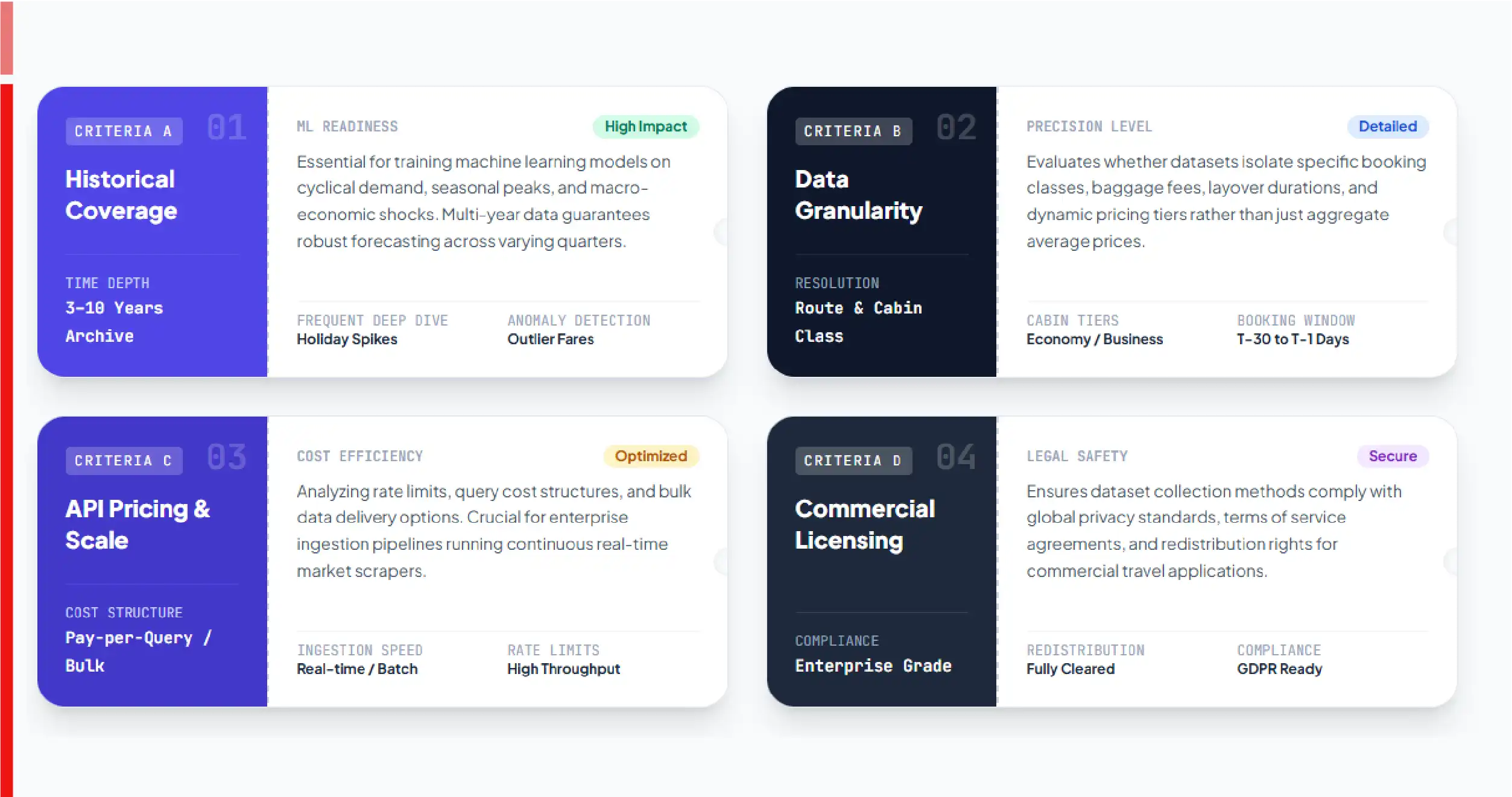
The travel industry operates in an environment where flight prices, schedules, inventory, and availability can change rapidly. These challenges made dependable data collection and normalization essential for the client.
Constant Fare Fluctuations
Airline fares can change multiple times throughout a day based on demand, inventory, booking windows, competitor pricing, and market conditions. Without continuous Flight Price Data Intelligence, the client struggled to distinguish genuine market movements from temporary changes and capture reliable pricing patterns.
Need for Real-Time Availability
Travel applications require current information because stale prices can produce inaccurate search results and poor customer experiences. The absence of a dependable real time flight price data API made it difficult to refresh fare information quickly and synchronize pricing with changing airline inventory across routes.
Fragmented Data Sources
Flight information was distributed across airline websites, aggregators, travel portals, and mobile applications, each using different structures and naming conventions. Building a unified Real-Time Data API required collecting diverse sources while maintaining consistent fields, formats, timestamps, currencies, and route identifiers.
Historical Commercial Intelligence
The client needed long-term pricing information to analyze trends, seasonality, route competitiveness, and fare behavior. Existing sources did not provide sufficient continuity for constructing a dependable commercial flight price dataset, limiting historical comparisons and reducing confidence in strategic market analysis.
Machine Learning Data Quality
Predictive systems require clean, structured, sufficiently granular, and consistently labeled datasets. Missing fields, duplicated records, inconsistent currencies, and irregular timestamps could undermine model performance. Creating a machine learning ready flight dataset therefore required systematic validation, normalization, deduplication, and quality monitoring.
Our Approach
Airline Data Scraping
We implemented scalable Airline Data Scraping workflows to collect flight details from relevant airline and travel sources. The framework captured route information, schedules, fare classes, prices, taxes, baggage details, stops, availability, timestamps, and related attributes while supporting frequent collection cycles.
Multi-Source Fare Collection
Our system collected fare information across airlines, aggregators, and travel platforms to create broader market visibility. Source-specific extraction logic handled different layouts and response structures before transforming records into standardized schemas suitable for downstream analytics, comparison engines, dashboards, and machine learning workflows.
Historical Data Structuring
Historical flight records were organized using standardized route, airline, date, fare, timestamp, and market attributes. This structure enabled longitudinal analysis and allowed the client to compare pricing behavior across booking windows, destinations, seasons, carriers, travel periods, and geographic markets.
Data Validation and Normalization
We applied validation routines to identify missing values, duplicates, invalid fares, inconsistent airport codes, currency differences, and anomalous records. Normalization transformed source-specific information into consistent datasets, improving analytical reliability and making the resulting data easier to consume through APIs and business intelligence systems.
API-Based Delivery
Collected information was processed into structured API-ready outputs for flexible consumption. Automated pipelines supported regular updates, scalable requests, and integration with client applications. This architecture allowed teams to access current and historical flight information without repeatedly managing source-level collection and transformation processes.
Results Achieved
The implemented solution improved data availability, consistency, historical visibility, and analytical usability while creating a scalable foundation for intelligent travel applications.
| Metric | Before Solution | After Solution | Improvement | Coverage | Refresh Frequency | Data Points | Accuracy Target | Records/Month |
|---|---|---|---|---|---|---|---|---|
| Airlines Monitored | 28 | 74 | 164% | Global | Daily | 18 | 98.2% | 2.4M |
| Routes Covered | 4,500 | 18,700 | 316% | 42 Countries | Daily | 22 | 98.5% | 8.7M |
| Airports Covered | 310 | 1,180 | 281% | International | Daily | 16 | 99.0% | 5.1M |
| Historical Records | 6.2M | 48.5M | 682% | Global | Archived | 25 | 98.7% | 48.5M |
| Fare Observations | 11M | 96M | 773% | Multi-Market | Hourly | 31 | 98.9% | 96M |
| API Response Coverage | 61% | 97% | 36 pts | Global | Real-Time | 20 | 99.1% | 12.6M |
| Duplicate Records | 8.4% | 1.2% | 86% reduction | All Sources | Continuous | 14 | 99.3% | 1.1M |
| Currency Normalization | 72% | 99% | 27 pts | 38 Currencies | Continuous | 12 | 99.0% | 7.8M |
| Data Processing Time | 14 hrs | 2.8 hrs | 80% faster | Global | Automated | 19 | 98.8% | 9.3M |
| Machine Learning Usability | 54% | 96% | 42 pts | Historical + Live | Automated | 28 | 99.2% | 21.4M |
Expanded Market Coverage
The solution substantially expanded airline, route, airport, and fare coverage. The client could monitor more markets simultaneously and develop richer competitive intelligence by combining information from diverse geographic regions and flight categories.
Stronger Historical Intelligence
Structured historical records enabled the client to analyze fare evolution across routes, airlines, seasons, booking windows, and travel dates. This improved visibility into recurring pricing patterns and supported more informed forecasting, benchmarking, and strategic planning.
Faster Data Availability
Automated collection and API delivery reduced delays between source changes and downstream data availability. Teams gained access to fresher pricing information, allowing applications to respond more effectively to rapidly changing fares, schedules, and availability conditions.
Improved Dataset Quality
Validation, normalization, and deduplication significantly improved consistency across collected records. The resulting datasets contained standardized attributes and timestamps, making them easier to integrate into dashboards, analytical systems, reporting workflows, and machine learning environments.
Scalable Travel Intelligence
The architecture established a scalable foundation for future expansion into additional airlines, destinations, travel platforms, and booking applications. The client could increase data volume without redesigning its complete collection and delivery framework, supporting sustainable product growth.
Client's Testimonial
"Working with the data team gave us a much stronger foundation for our flight intelligence products. Previously, our pricing information came from fragmented sources and required substantial manual effort to clean, compare, and interpret. The structured datasets and API-driven delivery changed that workflow completely. We now have broader route coverage, more consistent historical records, and significantly fresher fare information. Our analytics team can study pricing movements with greater confidence, while our product team can integrate structured flight information into applications without repeatedly handling source-level complexity. The historical coverage has also been valuable for understanding seasonal movements and booking-window behavior. Most importantly, the solution has given us flexibility to scale into additional markets without rebuilding our entire data infrastructure. The combination of structured extraction, validation, normalization, and continuous updates has made flight data much more useful across our organization, from business intelligence and forecasting to travel product development."
Conclusion
This case study demonstrates how structured flight intelligence can turn fragmented aviation information into a strategic resource for modern travel businesses. By combining historical records, current fares, route attributes, airline information, availability signals, and standardized timestamps, the solution created a dependable foundation for analytics and intelligent applications. The client gained broader market visibility while improving data consistency, refresh speed, historical analysis, and machine learning readiness. Businesses seeking to Scrape Aggregated Flight Fares can use similar architectures to monitor competitive pricing across airlines and travel platforms. Organizations can also Scrape Travel Website Data to strengthen market intelligence, benchmarking, and fare discovery workflows. As mobile booking continues to expand, businesses may Scrape Travel Mobile App data to complement web-based sources and develop broader pricing intelligence. Ultimately, combining scalable extraction with validation, normalization, historical storage, and API delivery enables travel companies to make faster, more informed decisions while creating flexible data infrastructure for future aviation intelligence products and predictive applications.
FAQs
Unlock the Full Report
Enter your details to access premium pricing intelligence insights