Transforming Ride-Hailing Strategy with Web Scraping Bolt & Uber Price Data
Introduction
In a competitive ride-hailing market, our client faced significant challenges in tracking dynamic pricing across multiple platforms. By leveraging Web Scraping Bolt & Uber Price Data, we enabled the client to collect accurate, real-time pricing information from both Bolt and Uber services.
With the insights gained, the client could enhance Bolt & Uber Ride-hailing price monitoring, identifying trends, peak pricing hours, and regional variations. This empowered the client to make informed decisions about competitive pricing strategies and optimize promotions effectively.
Additionally, the implementation of Uber Rentals Car Rental Data Scraping allowed the client to monitor rental-specific pricing fluctuations, providing a more comprehensive understanding of the overall ride-hailing ecosystem. The aggregated data supported predictive analytics, enabling proactive adjustments rather than reactive strategies.
Ultimately, this approach helped the client overcome challenges in price monitoring, reduce revenue losses, and gain a competitive edge in the ride-hailing industry. The project demonstrated the power of targeted web scraping for actionable business intelligence.
The Client
Our client, a leading mobility analytics firm, needed precise insights into urban ride-hailing dynamics to stay ahead of competition. They sought to understand pricing trends across different cities to optimize strategies and improve customer engagement. Using City-wise Uber and Bolt fare trend analysis, they gained clear visibility into fare fluctuations, peak demand periods, and regional pricing patterns.
To maintain competitive intelligence, the client relied on Real-time ride-hailing price tracking, which provided immediate updates on fare changes, helping them adjust pricing models and promotional offers effectively.
Furthermore, Bolt Car Rental Data Scraping enabled the client to access detailed rental-specific pricing and availability information, ensuring a comprehensive understanding of both standard ride-hailing and rental services.
By leveraging these insights, the client successfully enhanced decision-making, optimized pricing strategies, and strengthened their market position in the dynamic ride-hailing ecosystem.
Challenges in the Car Rental Industry
The client, a leading mobility analytics firm, faced multiple challenges in tracking dynamic ride-hailing and car rental pricing across cities. Leveraging Web scraping Uber Ride-hailing price data and other datasets was crucial to overcome information gaps and maintain competitive insights.
1. Inconsistent Pricing Across Cities
Monitoring fares across different regions was difficult due to inconsistent pricing patterns. The client struggled to maintain accurate Bolt Ride-hailing price monitoring, leading to delayed strategy adjustments and missed opportunities for optimizing dynamic pricing in real time.
2. Lack of Real-Time Insights
Rapidly changing ride-hailing fares demanded up-to-date data. The absence of Real-time ride-hailing pricing intelligence limited the client’s ability to respond to market fluctuations and adjust pricing strategies effectively across multiple urban locations.
3. Difficulty in Tracking Car Rental Trends
Understanding rental-specific fares was complex due to scattered data. The client needed a reliable Car Rental Price Trends Dataset to analyze pricing patterns, seasonality, and competitive rates for informed decision-making in urban mobility services.
4. Location-Based Data Challenges
Accurate fare analysis required integrating location-specific details. Limited access to a Car Rental Location Dataset hampered the client’s ability to correlate pricing trends with geographical factors and optimize regional ride-hailing and rental strategies.
5. High Volume Data Processing
Collecting and processing vast amounts of Uber and Bolt fare information was cumbersome. The client faced challenges in efficiently managing Web scraping Uber Ride-hailing price data to derive actionable insights without overwhelming storage or analytics resources.
Our Approach
1. Intelligent Data Harvesting
We designed a smart collection system that captured pricing and service information seamlessly across multiple platforms. This method reduced manual effort, ensured comprehensive coverage, and allowed the client to access a rich, reliable dataset for strategic planning.
2. Dynamic Alert Mechanism
A live tracking system was implemented to detect sudden changes in fares. The client received timely notifications, enabling proactive interventions and rapid decision-making, ensuring they stayed ahead in the competitive urban mobility landscape.
3. Location-Centric Insights
Data was mapped and analyzed by city and region to uncover localized patterns. This spatial approach highlighted demand hotspots, peak times, and regional pricing behavior, allowing tailored strategies that were highly relevant to each market segment.
4. Streamlined Data Transformation
Collected information was cleaned, structured, and normalized for consistency. This step eliminated noise and ensured accuracy, making it easier to extract meaningful patterns and generate actionable insights without being hindered by fragmented or messy datasets.
5. Strategic Visualization and Reporting
Key findings were presented through intuitive dashboards and visual reports. This approach converted raw data into clear, actionable insights, empowering the client to make data-driven pricing decisions, optimize operations, and uncover competitive opportunities efficiently.
Results Achieved
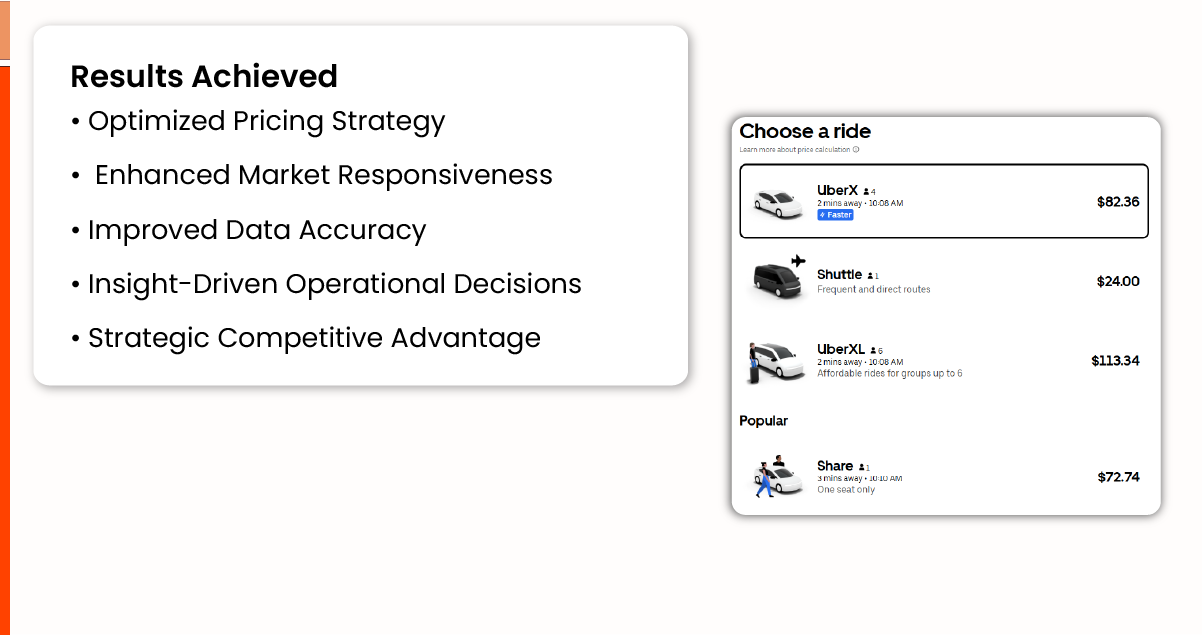
Our approach delivered measurable outcomes, transforming raw data into actionable insights, enabling strategic decisions, and enhancing overall operational efficiency.
1. Optimized Pricing Strategy
Through detailed analysis, the client identified patterns in fare fluctuations, enabling refined pricing strategies. This led to more competitive offerings, increased customer retention, and better revenue management across multiple regions.
2. Enhanced Market Responsiveness
The client gained the ability to respond quickly to sudden changes in service demand or competitor pricing, improving agility and ensuring timely adjustments that kept them ahead in the competitive urban mobility environment.
3. Improved Data Accuracy
Cleaning and standardizing data eliminated inconsistencies, allowing the client to rely on precise, trustworthy information. Accurate datasets facilitated better forecasting, planning, and reduced decision-making risks across ride-hailing and rental operations.
4. Insight-Driven Operational Decisions
Visual dashboards and reporting enabled the client to interpret complex datasets easily. Insights guided fleet allocation, peak-hour strategies, and service expansion decisions, aligning operations with market demand efficiently.
5. Strategic Competitive Advantage
By combining historical trends and real-time analysis, the client identified opportunities to outperform competitors, optimize service offerings, and increase overall market share, resulting in sustained growth and stronger positioning within the urban mobility landscape.
Sample Data Table
| City | Avg Fare (Standard) | Avg Fare (Premium) | Peak Hour Rate | Competitor Avg Fare | Price Change (%) | Observed Demand Index |
|---|---|---|---|---|---|---|
| New York | 15.20 | 28.50 | 1.5x | 16.00 | +5% | 87 |
| Los Angeles | 12.75 | 25.40 | 1.4x | 13.10 | +3% | 79 |
| Chicago | 13.50 | 26.20 | 1.6x | 13.80 | +4% | 82 |
| Houston | 11.80 | 23.50 | 1.3x | 12.10 | +3% | 75 |
| Miami | 14.10 | 27.00 | 1.7x | 14.50 | +6% | 88 |
| Boston | 13.00 | 26.00 | 1.5x | 13.30 | +4% | 80 |
| Seattle | 12.50 | 24.50 | 1.4x | 12.90 | +3% | 77 |
| San Francisco | 15.80 | 29.00 | 1.6x | 16.20 | +5% | 85 |
| Atlanta | 12.00 | 24.00 | 1.3x | 12.40 | +3% | 76 |
| Denver | 13.20 | 25.50 | 1.5x | 13.60 | +4% | 81 |
Client’s Testimonial
"Partnering with this team has transformed the way we monitor urban mobility pricing. Their data collection and analysis capabilities provided us with accurate, real-time insights that were previously impossible to gather. With their support, we optimized our pricing strategies, improved operational decisions, and gained a clear competitive advantage across multiple cities. The visual dashboards and reports made complex data easy to interpret, enabling our teams to act swiftly and confidently. Their professionalism, technical expertise, and proactive approach exceeded our expectations, making them an invaluable partner in our growth journey."
Conclusion
In conclusion, the project successfully addressed the client’s challenges in monitoring dynamic ride-hailing and car rental markets. By implementing advanced data collection, real-time tracking, and location-specific analysis, the client gained actionable insights that improved decision-making, operational efficiency, and market responsiveness. The structured approach to cleaning, standardizing, and visualizing data allowed the client to identify trends, optimize pricing strategies, and uncover new opportunities. Moreover, the ability to respond quickly to market fluctuations strengthened the client’s competitive position across multiple regions. Overall, this case study demonstrates the significant value of leveraging Car Rental Data Intelligence to transform raw information into strategic, actionable business outcomes, enabling sustainable growth in a complex, rapidly evolving industry.
FAQs
Unlock the Full Report
Enter your details to access premium pricing intelligence insights