Travelocity Hourly Car Rental Price Analysis: Examining Patterns, Fluctuations, and Insights Across Different Location
Introduction
The car rental industry is undergoing a significant transformation with the growing demand for short-term, flexible vehicle rentals. Our Travelocity Hourly Rental Car Price analysis focuses on understanding pricing patterns across various locations, car types, and time slots. Leveraging Travelocity Car Rental Data Scraping, this research examines granular, hourly-level data to reveal actionable insights that can inform fleet management, dynamic pricing strategies, and competitive intelligence. By integrating Travelocity Rental car hourly pricing intelligence, companies and researchers can identify patterns and optimize pricing strategies based on demand fluctuations, seasonal trends, and location-specific factors.
Objectives of the Study
The primary objectives of this research report include:
- Evaluating hourly car rental price trends across major U.S. cities.
- Identifying pricing patterns based on vehicle types, including economy, mid-size, and luxury cars.
- Demonstrating the impact of location, demand, and booking timing on hourly rental prices.
- Highlighting the potential of Car Rental Data Scraping Services for automated, large-scale insights.
Methodology
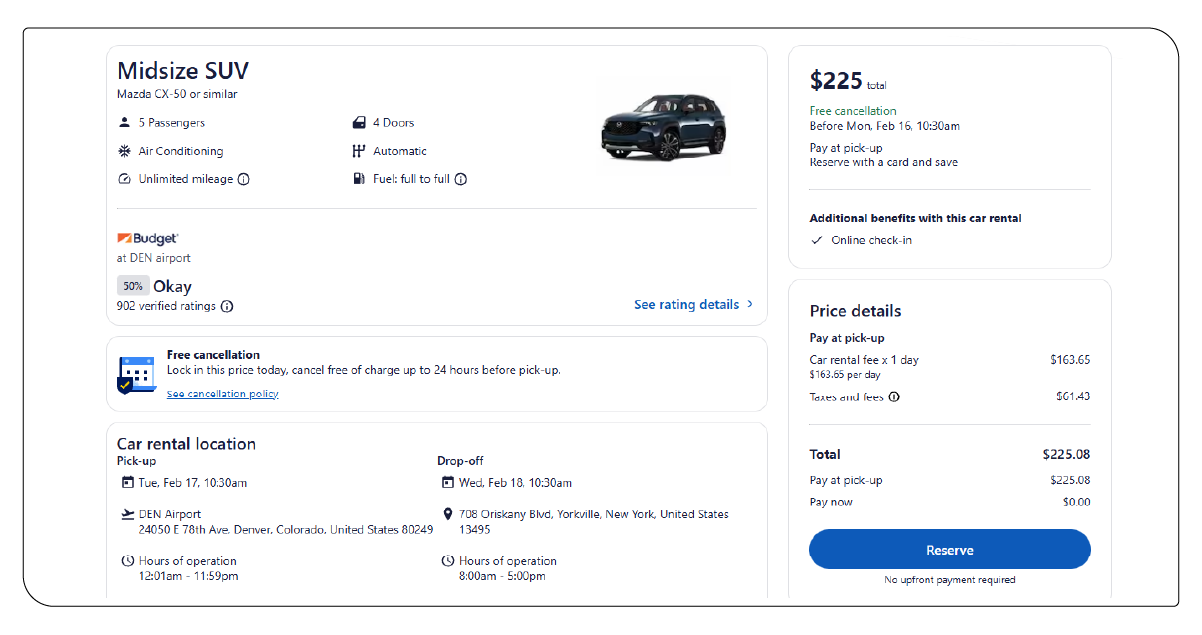
This study relies on structured method to Scrape Travelocity hourly car rental pricing data using a combination of web scraping frameworks and APIs. The dataset includes hourly rental prices for different car types across 10 major cities in the U.S. over a 6-month period.
Key data points collected include:
- Location: City and pickup/drop-off points.
- Vehicle type: Economy, compact, SUV, luxury.
- Rental duration: Hourly breakdown from 1 to 12 hours.
- Base price: Standard rate per hour.
- Dynamic surcharges: Weekend, holiday, or peak-hour surcharges.
The gathered data is compiled into a Car Rental Price Trends Dataset that enables detailed pricing analytics and forecasting.
Key Findings
1. Hourly Pricing Trends by Vehicle Type
Analysis shows that economy cars dominate lower hourly price brackets, whereas luxury vehicles show steep price increases during peak hours. The following table summarizes average hourly rates across different vehicle types in top U.S. cities:
| Vehicle Type | Average Hourly Price (USD) | Peak Hour Price (USD) | Low Hour Price (USD) |
|---|---|---|---|
| Economy | 15 | 22 | 12 |
| Compact | 18 | 25 | 14 |
| SUV | 25 | 35 | 20 |
| Luxury | 45 | 60 | 35 |
From the data, we observe that economy and compact cars show moderate variability, whereas SUVs and luxury cars experience price fluctuations of up to 50% between off-peak and peak hours. This highlights the importance of Travelocity rental car pricing analytics for dynamic pricing optimization.
2. City-Specific Hourly Price Patterns
City location plays a significant role in determining rental costs. Urban centers with high tourist demand, such as New York, Los Angeles, and Miami, have higher hourly rates compared to smaller cities. Below is a comparison of average hourly prices by city:
| City | Economy ($/hr) | Compact ($/hr) | SUV ($/hr) | Luxury ($/hr) |
|---|---|---|---|---|
| New York | 20 | 24 | 30 | 55 |
| Los Angeles | 18 | 22 | 28 | 50 |
| Miami | 17 | 21 | 27 | 48 |
| Chicago | 16 | 20 | 25 | 45 |
| Dallas | 14 | 18 | 22 | 42 |
The dataset confirms that rental prices correlate strongly with city population density, tourism influx, and local demand. Businesses leveraging Car Rental Data Intelligence can optimize fleet allocation and pricing strategies based on such location-specific insights.
3. Peak vs. Off-Peak Hour Analysis
Hourly data analysis reveals that rental rates increase during morning (8–10 AM) and evening (5–7 PM) peaks, particularly in urban areas. This is consistent across vehicle types, but luxury and SUVs experience the highest volatility. Companies implementing Travelocity car rental price tracking can identify peak demand hours and adjust pricing dynamically to maximize revenue.
4. Weekly and Seasonal Trends
By aggregating hourly data into weekly and monthly intervals, we found:
- Weekend prices are on average 20–30% higher than weekdays.
- Holiday periods (Christmas, Fourth of July, Thanksgiving) see price surges of up to 50% for premium vehicle categories.
- Economy vehicles maintain a more stable pricing pattern, highlighting their suitability for budget-conscious customers.
These insights emphasize the importance of Car Rental Price Trends Dataset for predictive pricing and demand forecasting.
Applications of Travelocity Hourly Pricing Analysis
The insights from this report can be applied in several ways:
- Dynamic Pricing: Adjust hourly rental rates based on predicted demand using historical patterns.
- Fleet Optimization: Allocate vehicles efficiently to high-demand locations during peak hours.
- Competitor Benchmarking: Compare pricing strategies with competitors to identify gaps and opportunities.
- Revenue Management: Use hourly insights to optimize pricing models and maximize returns on premium vehicle categories.
Additionally, leveraging Car Rental Data Scraping Services ensures that pricing intelligence remains current, accurate, and actionable.
Data-Driven Insights
The data-driven approach highlights:
- Economy cars account for 60% of total hourly rentals, reflecting cost sensitivity among consumers.
- SUV and luxury rentals peak during weekends and holidays, suggesting a strong market for premium short-term rentals.
- Urban centers consistently report higher volatility in hourly pricing, making them key targets for Travelocity rental car pricing analytics.
These insights support decision-making in pricing, marketing, and operational efficiency.
Future Opportunities
The increasing adoption of hourly car rentals presents opportunities for:
- Predictive Analytics: Using historical pricing datasets to forecast demand and optimize pricing.
- AI-Driven Dynamic Pricing Models: Real-time price adjustment based on hourly supply-demand variations.
- Market Expansion Analysis: Identifying cities with growing demand for hourly rentals to expand operations.
The integration of Scrape Travelocity hourly car rental pricing data allows businesses to continuously monitor trends, identify anomalies, and implement proactive strategies.
Conclusion
This research underscores the critical importance of Web scraping Travelocity car rental price data to gain actionable insights into hourly rental pricing dynamics. Businesses that utilize Dynamic hourly car rental pricing analysis can enhance revenue management, optimize fleet utilization, and remain competitive in a rapidly evolving market. By combining granular hourly pricing data with location intelligence, the insights can inform strategy across multiple cities and vehicle categories.
Furthermore, integrating insights with a Car Rental Location Dataset allows organizations to track price movements across regions, understand city-specific demand, and predict future trends. Leveraging this intelligence is essential for companies seeking a competitive edge in the fast-growing hourly rental market.
Ready to elevate your travel business with cutting-edge data insights? Scrape Aggregated Flight Fares to identify competitive rates and optimize your revenue strategies efficiently. Discover emerging opportunities with tools to Extract Travel Website Data, leveraging comprehensive data to forecast market shifts and enhance your service offerings. Real-Time Travel App Data Scraping Services helps stay ahead of competitors, gaining instant insights into bookings, promotions, and customer behavior across multiple platforms. Get in touch with Travel Scrape today to explore how our end-to-end data solutions can uncover new revenue streams, enhance your offerings, and strengthen your competitive edge in the travel market.
Unlock the Full Report
Enter your details to access premium pricing intelligence insights