Overwater Bungalow Price Parity Monitoring across Booking.com, Expedia, and Agoda
Introduction
The case study highlights how a luxury resort group strengthened revenue control by implementing Overwater bungalow price parity monitoring directly within its daily pricing workflow. The client faced challenges detecting subtle rate differences across OTAs and wholesalers, which caused hidden revenue leakage at the room-type level. By tracking prices at granular intervals, the system exposed unauthorized discounts, currency-based inconsistencies, and delayed updates impacting overwater bungalow inventory.
Using Travel Data Intelligence Solutions, the client gained centralized dashboards that mapped real-time prices across all distribution channels. These insights allowed revenue managers to trace parity violations back to specific partners and booking windows, enabling faster corrective action and improved contract compliance.
The introduction of Overwater bungalow rate parity intelligence further supported historical trend analysis, helping teams anticipate repeat violations and optimize pricing rules. Ultimately, the client minimized rate leakage, restored channel parity, improved customer trust, and protected margins on premium overwater bungalow offerings, reinforcing long-term pricing discipline and revenue stability.
The Client
The client is a premium hospitality brand operating luxury resorts with a strong emphasis on revenue optimization and brand consistency. Managing multiple global and regional distribution partners, the client needed reliable visibility into how room prices appeared across digital channels while maintaining control over premium inventory performance using OTAs Data Scraping Services.
To support internal revenue and distribution teams, the client adopted structured insights that consolidate multi-channel pricing into a single analytical view. This approach enabled faster identification of discrepancies and improved decision-making through detailed Room-level OTA pricing analytics.
With access to a comprehensive Hotel Room Price Trends Dataset, the client continuously monitors historical and real-time pricing movements across OTAs and direct platforms. These insights help forecast demand, benchmark competitors, and enforce pricing discipline. Overall, the client leverages data-driven intelligence to strengthen channel compliance, protect margins, and ensure consistent pricing experiences for travelers across all booking touchpoints.
Challenges in the Hotel Industry
Managing premium overwater bungalow inventory across multiple online travel channels exposed the client to complex pricing risks. Limited visibility, delayed updates, and fragmented data made it difficult to detect inconsistencies, protect margins, and enforce consistent pricing policies globally effectively today.
Booking.com Price Visibility Gaps
Tracking real-time rates on Booking.com was inconsistent, as unauthorized discounts appeared without alerts. Dependence on Booking.com Overwater Bungalow Price Scrape revealed gaps in monitoring frequency, currency conversions, and room-type mapping, allowing parity violations to persist unnoticed across regions for partners.
Fragmented Pricing Intelligence
Disparate data sources prevented a unified pricing view across departments. Without centralized Hotel Data Intelligence, teams relied on manual checks, causing delays, inconsistent reports, and misaligned decisions that weakened enforcement of pricing rules for overwater bungalows during high-demand periods globally.
Expedia Rate Leakage Risks
Price volatility on Expedia introduced hidden leakage, especially for premium room types. Incomplete Scraped Expedia Overwater Bungalow Price Data limited visibility into flash sales and member-only rates, making it difficult to reconcile discrepancies and respond before bookings impacted revenue streams.
Agoda Update Delays
Agoda listings often reflected delayed updates and regional pricing variations. The inability to extract Agoda Overwater Bungalow Price Data in real time caused blind spots, preventing quick identification of undercutting partners and prolonging exposure to sustained parity breaches across channels.
Lack of Continuous Parity Monitoring
The client lacked automation to continuously compare rates across all platforms. Without Scraping prices to monitor overwater bungalow rate parity, violations were detected too late, reducing negotiation leverage, increasing manual workload, and compromising long-term pricing discipline for revenue teams globally.
Our Approach
Channel-Wise Data Mapping
We mapped all OTA channels and aligned overwater bungalow room types using standardized identifiers. This ensured accurate like-to-like comparisons, eliminated mismatches caused by naming variations, and created a reliable foundation for detecting true rate leakage across platforms.
Automated Price Collection Framework
Our system continuously collected real-time prices at defined intervals, covering multiple currencies and geographies. Automation removed manual dependency, improved data freshness, and enabled faster detection of sudden discounts, flash sales, or unauthorized promotional rates.
Room-Type Level Parity Analysis
We designed analytics focused specifically on room-level comparisons rather than property-level averages. This granular approach highlighted parity violations unique to overwater bungalows, helping revenue teams identify exactly where and how pricing policies were being breached.
Intelligent Alerts and Dashboards
Custom alerts notified stakeholders immediately when deviations crossed predefined thresholds. Interactive dashboards visualized trends, violators, and historical patterns, allowing teams to prioritize actions, validate partner behavior, and support discussions with distribution partners confidently.
Historical Trend and Root-Cause Insights
Beyond detection, we analyzed long-term data to uncover recurring issues such as delayed updates or regional pricing tactics. These insights helped the client refine contracts, adjust pricing rules, and proactively prevent future parity violations.
Results Achieved
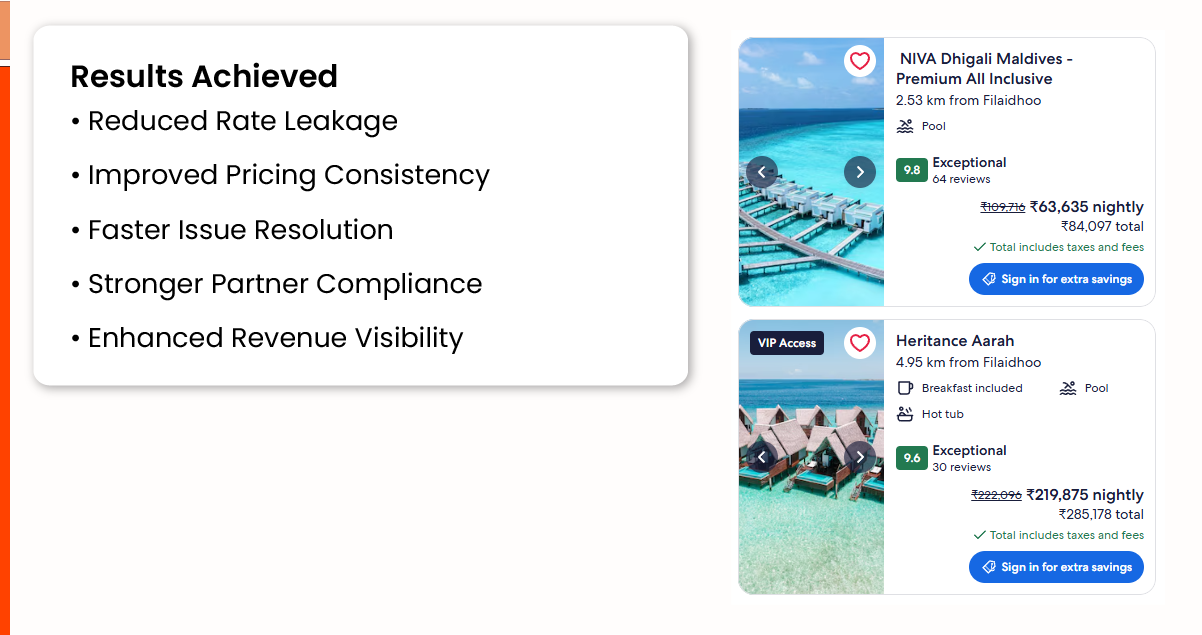
The engagement delivered measurable improvements in pricing control, revenue protection, and operational efficiency across premium overwater bungalow inventory channels.
Reduced Rate Leakage
Unauthorized discounts and undercutting were identified early, enabling swift corrective action. This significantly reduced revenue leakage across high-value room types and protected margins during peak demand periods.
Improved Pricing Consistency
Consistent room-level pricing was achieved across major booking platforms. Guests experienced uniform rates, strengthening brand trust and minimizing confusion caused by conflicting prices online.
Faster Issue Resolution
Automated alerts replaced manual checks, allowing revenue teams to respond to discrepancies within hours instead of days. This improved agility in managing OTA relationships.
Stronger Partner Compliance
Clear evidence of violations improved discussions with distribution partners. The client enforced contracts more effectively and reduced repeat pricing issues over time.
Enhanced Revenue Visibility
Centralized dashboards provided complete visibility into pricing trends, supporting smarter forecasting and long-term pricing strategy decisions.
| Result Metric | Before Engagement | After Implementation | Measured Improvement |
|---|---|---|---|
| Monthly rate violations detected | 30–35 cases | 5–7 cases | ↓ ~80% reduction |
| Average issue detection time | 72–120 hours | 2–4 hours | ↓ Faster by over 90% |
| Revenue loss from price leakage | ~12–15% annually | <3% annually | Significant margin protection |
| Manual monitoring hours per week | 25–30 hours | 5–7 hours | ↓ ~75% effort reduction |
| Room-level price consistency score | 65% | 95%+ | Strong pricing alignment |
Client’s Testimonial
"Working with this team transformed how we manage pricing across our premium room categories. What once took days of manual checks is now visible in near real time, allowing us to act quickly and confidently. The clarity at room-type level helped us identify hidden issues, strengthen partner accountability, and protect our margins. Their structured insights and responsive support have become an essential part of our revenue strategy, enabling better decisions and stronger pricing discipline across all distribution channels."
Conclusion
In conclusion, the case study demonstrates how data-driven pricing intelligence can significantly strengthen revenue control for premium hospitality segments. By moving from manual checks to automated, room-level monitoring, the client gained timely visibility into pricing inconsistencies and resolved parity issues before they impacted bookings. The structured insights improved internal coordination, enhanced partner compliance, and supported more confident revenue decisions. Most importantly, the approach helped protect margins while preserving a consistent brand experience for guests across all booking channels. Leveraging advanced tools such as the Overwater Bungalow Resort Intelligence API, the client established a scalable framework for ongoing price governance. This foundation now supports proactive pricing strategies, long-term profitability, and sustainable growth in an increasingly competitive luxury travel marketplace.
FAQs
Unlock the Full Report
Enter your details to access premium pricing intelligence insights