Multi-Year Airline Ticket Price Panel Dataset with Booking Dates, Flight Details, and Route-Level Fare Data (2022–2025)
Introduction
Our Multi-year airline ticket price panel dataset provides airlines, travel agencies, and analysts with a robust foundation to track pricing trends over extended periods. By monitoring fares across numerous routes, the dataset highlights patterns, seasonal fluctuations, and competitor pricing strategies, enabling more informed decision-making and revenue optimization.
Leveraging the Historical Route-Level Flight Fare Dataset, our analysis allows stakeholders to examine market behaviors, identify pricing anomalies, and anticipate shifts in demand. This historical perspective is crucial for strategic planning, helping airlines adjust flight capacities, promotional campaigns, and dynamic pricing models to maximize profitability.
The inclusion of the Airline Price Change Dataset ensures that every fare adjustment is captured in real time, providing a granular view of price variations across multiple carriers and geographies.
This comprehensive case study demonstrates how data-driven insights from our datasets empower airlines and travel platforms to refine pricing strategies, enhance competitiveness, and deliver greater value to passengers while optimizing revenue management across global markets.
The Client
Our client, a leading global airline analytics firm, leverages our Multi-Year Airline Pricing Panel Dataset to gain a deep understanding of fare trends, seasonal demand fluctuations, and competitor pricing strategies. Their team uses this rich dataset to optimize revenue management and improve flight pricing strategies across multiple regions and routes.
With our Flight-Level Fare & Booking Data Analytics, they can analyze granular ticketing patterns, assess booking behaviors, and forecast market trends with precision. This enables timely adjustments to fare structures and promotional campaigns, ensuring competitiveness in a dynamic aviation market.
By utilizing our Airline Data Scraping Services, the client accesses real-time updates on fare changes and competitor offerings, allowing proactive decision-making and strategic planning.
Overall, our partnership equips the client with actionable insights that enhance operational efficiency, improve customer satisfaction, and maximize profitability while maintaining a strong competitive edge in the airline industry.
Challenges in the Travel Industry
The client faced significant hurdles in navigating the complex aviation market. Accessing accurate, timely, and comprehensive fare information across multiple routes and airlines was essential. Leveraging our Airline Dynamic Pricing Historical Dataset enabled them to address these challenges effectively.
1. Incomplete Historical Data:
Without a reliable Route-Wise Airline Ticket Price Intelligence framework, the client struggled to analyze long-term pricing trends and competitor strategies. Gaps in historical data limited forecasting accuracy and hindered the creation of effective dynamic pricing models across global routes.
2. Real-Time Fare Monitoring:
Monitoring frequent fare fluctuations was difficult without an integrated Multi-Year Flight-Level Fare & Booking Dataset. Inconsistent updates caused delayed insights, reducing the client’s ability to react quickly to competitor pricing and market demand changes.
3. Complex Route Analysis:
Managing diverse global routes required seamless integration with a Global Flight Schedule Dataset. Variations in schedules and cancellations complicated fare predictions, making route-level strategy planning more challenging for revenue management teams.
4. Competitive Intelligence Gaps:
Limited access to comprehensive Flight Price Data Intelligence hindered the client’s ability to benchmark fares against competitors, causing potential revenue loss and missed opportunities in capturing market share on high-demand routes.
5. Data Volume & Management:
Handling vast amounts of fare, booking, and schedule data was overwhelming. Ensuring accuracy, consistency, and accessibility across multiple datasets demanded advanced analytics infrastructure and significant technical expertise.
Our Approach
1. Tailored Data Integration:
We customized the data gathering process to match the client’s specific business needs, consolidating multiple sources into a cohesive system. This ensured actionable insights were aligned with strategic goals, enabling smarter planning and informed pricing decisions.
2. Predictive Trend Modeling:
By leveraging advanced forecasting techniques, we identified emerging trends before they became apparent in the market. This proactive modeling allowed the client to anticipate demand fluctuations and adjust strategies ahead of competitors, gaining a critical edge in pricing decisions.
3. Focused Route Analytics:
We segmented analysis by routes, uncovering unique travel patterns and fare behaviors. This granular approach revealed opportunities for optimization that broad, generic analyses often overlook, allowing precise strategies tailored to each route’s performance and potential.
4. Continuous Market Surveillance:
We implemented ongoing monitoring of market changes, competitor adjustments, and customer demand shifts. Real-time alerts and insights enabled rapid response to emerging scenarios, keeping the client agile and well-positioned to maximize revenue across varying market conditions.
5. Actionable Intelligence Delivery:
Complex data was transformed into intuitive dashboards and reports. By highlighting key trends, anomalies, and recommendations, the client’s team could immediately apply insights to decision-making, reducing analysis time and accelerating strategic execution.
Results Achieved
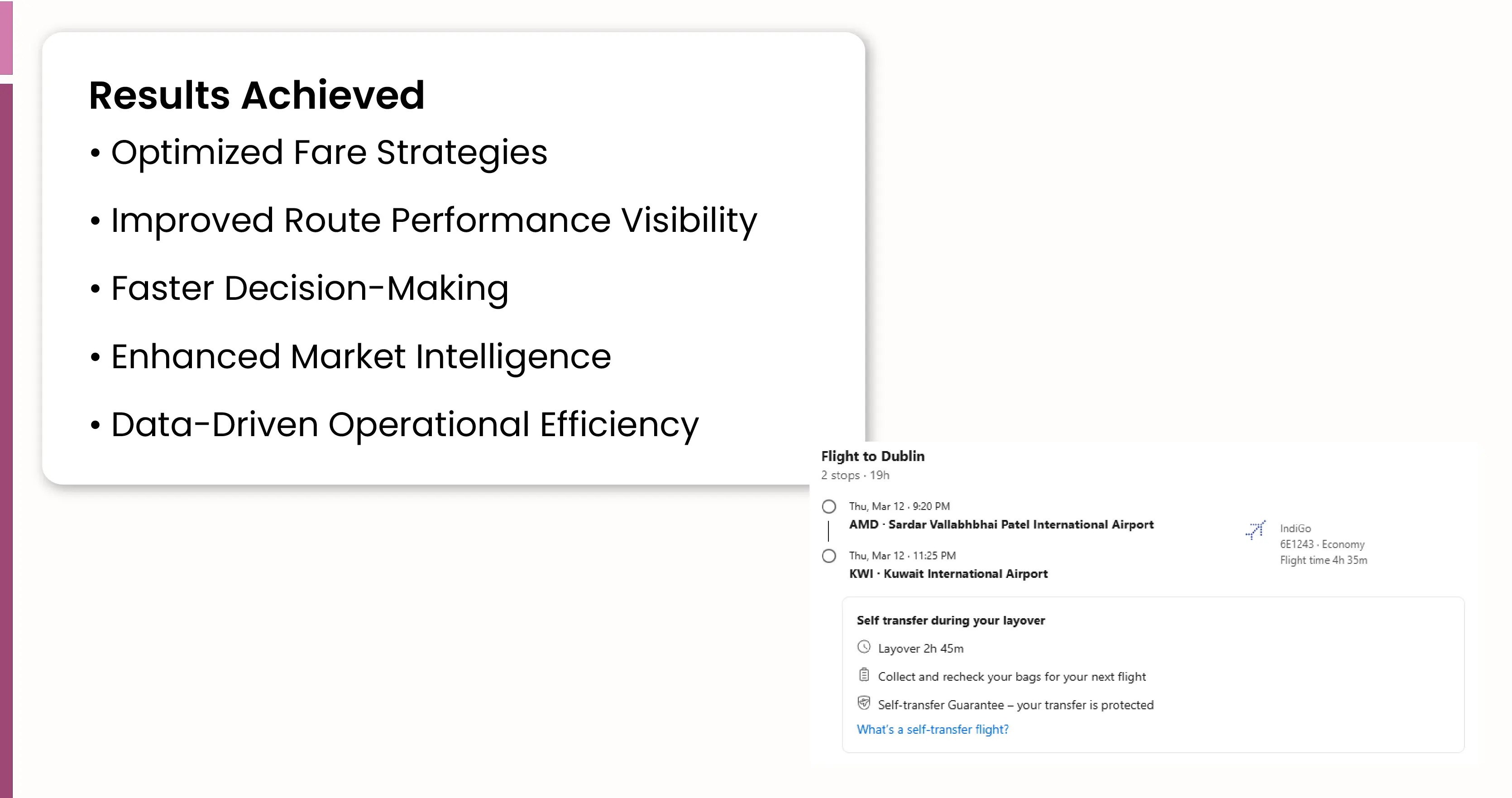
Our solutions delivered measurable improvements in pricing strategy, operational efficiency, and revenue management, driving actionable insights and tangible business outcomes.
1. Optimized Fare Strategies
Through precise analysis, we helped the client adjust fares dynamically, improving revenue capture across peak and off-peak periods. Insights allowed timely promotions, reducing unsold inventory while maximizing profitability for both domestic and international routes.
2. Improved Route Performance Visibility
By segmenting analysis route-wise, the client gained clear insights into demand fluctuations and competitor behavior. This enabled prioritization of high-potential routes and optimized allocation of flight capacity for maximum returns.
3. Faster Decision-Making
Real-time monitoring and dashboards provided the client with immediate visibility into fare and booking trends. Teams could make quicker strategic choices, reducing reaction time to competitor moves and market shifts.
4. Enhanced Market Intelligence
Continuous tracking of competitors’ offerings revealed pricing patterns, demand spikes, and opportunities for strategic adjustments. This intelligence allowed the client to proactively adapt and capture additional market share.
5. Data-Driven Operational Efficiency
Structured reporting and insights reduced manual analysis effort, enabling more accurate forecasting, better route planning, and streamlined internal decision-making processes, resulting in operational efficiency and higher overall profitability.
Route-Level Fare Data with Booking Dates and Flight Details (2022–2025)
| Booking Date | Flight Details | Route | Competitor Fare (USD) | Client Fare (USD) | Seats Sold | Revenue (USD) | Demand Change (%) | Fare Adjustment (%) | Notes |
|---|---|---|---|---|---|---|---|---|---|
| 2022-07-15 | AA123, 08:00 – 11:00 | NYC-LAX | 300 | 295 | 160 | 47,200 | +4 | +2 | Summer peak demand |
| 2023-11-10 | UA456, 12:00 – 14:30 | LAX-SFO | 140 | 145 | 130 | 18,850 | -2 | 0 | Competitor discount observed |
| 2024-06-05 | BA789, 18:30 – 06:30 | JFK-LHR | 750 | 740 | 100 | 74,000 | +7 | +3 | Seasonal high demand |
| 2023-03-22 | DL321, 09:00 – 15:00 | SFO-ORD | 200 | 198 | 140 | 27,720 | +3 | +1 | Balanced load |
| 2025-01-18 | AA654, 06:30 – 09:00 | MIA-ATL | 115 | 120 | 110 | 13,200 | -4 | -1 | Low demand weekday |
| 2024-08-30 | AF987, 07:00 – 09:00 | LHR-CDG | 195 | 190 | 125 | 23,750 | +3 | 0 | Competitive advantage captured |
| 2022-12-12 | UA852, 10:00 – 13:30 | ORD-SEA | 270 | 265 | 115 | 30,475 | +2 | +2 | Fare adjustment improved sales |
Client’s Testimonial
"The collaboration has been a game-changer for our pricing and route strategy. The team provided precise insights that were easy to act on, allowing us to adjust fares in real time. The dashboards are intuitive, giving our team instant clarity on trends and competitor activity. We discovered opportunities we hadn’t seen before, improved route performance, and boosted overall revenue. Their professionalism, timely updates, and practical guidance made implementation straightforward. This partnership has strengthened our data-driven decision-making and has become an essential part of our operational strategy."
Conclusion
In conclusion, our case study highlights how data-driven insights can transform airline revenue management and strategic planning. Leveraging the Global Flight Price Trends Dataset, the client was able to monitor fare fluctuations, anticipate demand, and optimize pricing across multiple routes efficiently. By utilizing Travel Aggregators Data Scraping Services, they gained a comprehensive view of competitor offerings and market dynamics, enabling proactive decision-making.
The integration of Travel Industry Web Scraping Services provided accurate, real-time intelligence, reducing manual effort and improving operational efficiency. Additionally, the Travel Mobile App Scraping Service allowed the client to capture dynamic pricing updates directly from mobile platforms, ensuring timely responses to market changes.
Overall, the project delivered measurable improvements in revenue, competitiveness, and strategic agility across the client’s global operations.
FAQs
Unlock the Full Report
Enter your details to access premium pricing intelligence insights