Analyzing Passenger Experience Using the Saudi Arabia Airport Lounge Dataset Across Jeddah, Riyadh, and Dammam
Introduction
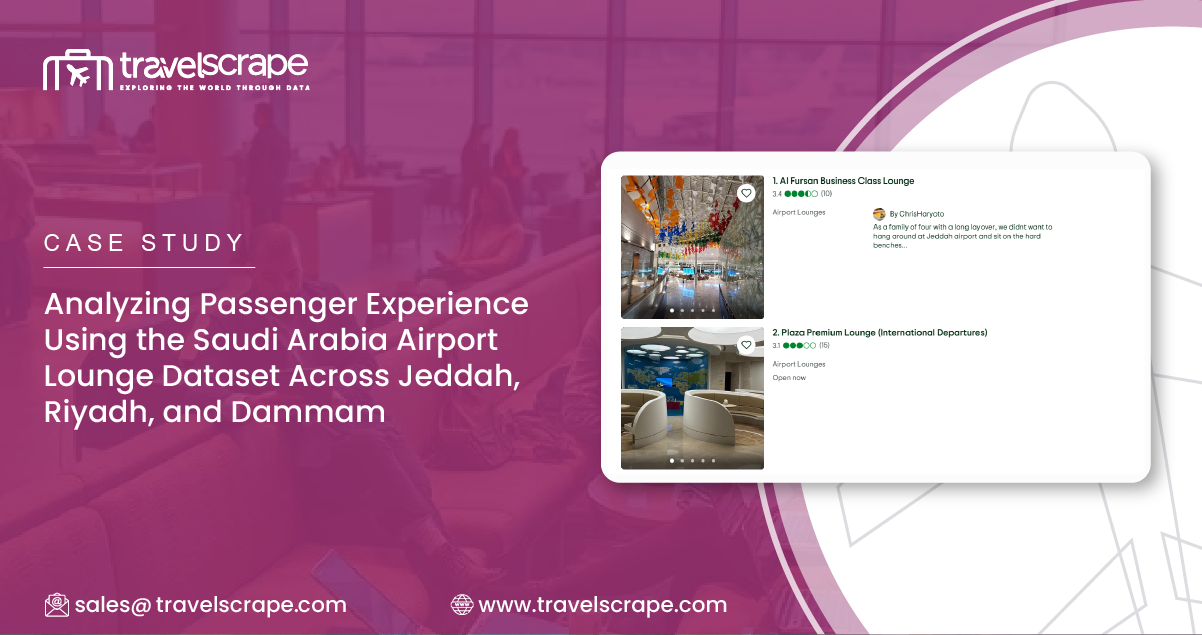
Our recent case study highlights how leveraging the Saudi Arabia Airport Lounge Dataset enabled comprehensive insights into airport lounge services across major airports in the Kingdom. By systematically collecting and analyzing data on lounges, we identified patterns in amenities, operational hours, and customer preferences that traditional research methods often miss.
Using the Airport Amenities Dataset, we were able to compare offerings across multiple lounges, including seating capacity, Wi-Fi availability, dining options, and premium services. This allowed airlines, travel agencies, and hospitality providers to tailor their strategies and improve passenger satisfaction.
The study relied on advanced Saudi Arabia airport lounge data scraping techniques, ensuring real-time, accurate, and structured datasets that could be easily integrated into dashboards and business intelligence tools.
Results demonstrated actionable insights, such as identifying underutilized lounges, optimizing service offerings, and enhancing overall passenger experience. This case study proves that high-quality airport data empowers stakeholders to make informed operational and strategic decisions.
The Client
Our client, a leading aviation analytics firm, specializes in providing actionable insights to airlines and airport operators across the Middle East. Leveraging Airline Data Scraping Services, they consolidate vast amounts of airline schedules, passenger trends, and lounge utilization metrics to support operational efficiency and strategic planning.
They recently partnered with us to access the Saudi airport premium lounge dataset, enabling a detailed understanding of lounge offerings, passenger preferences, and service gaps at key airports in Saudi Arabia. This dataset empowered the client to optimize premium lounge services and enhance passenger experiences.
In addition, our Real-Time Flight Data Scraping API allowed the client to monitor flight operations dynamically, track delays, and integrate live data into their dashboards for instant decision-making.
Through these solutions, the client strengthened their market intelligence, improved service quality, and maintained a competitive edge in the aviation analytics sector.
Challenges in the Travel Industry
Our client faced several uncommon challenges while optimizing airport lounge services and flight intelligence across Saudi Arabia. Addressing data accuracy, integration, and regional variations was critical. Advanced scraping and analytics tools enabled them to overcome these obstacles efficiently.
1. Inconsistent Lounge Data Across Airports
Collecting uniform lounge information was difficult due to varied formats and service listings. Leveraging the Saudi airport lounge data extraction API, the client ensured consistent, structured data, enabling precise comparisons and actionable insights across multiple Saudi airports without manual intervention.
2. Dynamic Flight Pricing Fluctuations
Frequent and unpredictable fare changes complicated planning. Using Flight Price Data Intelligence, the client could monitor live trends, identify anomalies, and provide recommendations for cost optimization, ensuring passengers received accurate pricing insights in real time.
3. Restricted Access to Jeddah Lounges
Access rules and policies varied significantly, making data collection complex. Jeddah airport lounge access scraping allowed the client to gather real-time information on eligibility, timings, and facilities, enhancing the accuracy of lounge availability data for travelers and service providers.
4. Riyadh Lounge Price Variations
Lounge pricing was inconsistent across locations, creating difficulties in benchmarking. Riyadh airport lounge pricing data scraping provided detailed cost insights, enabling the client to standardize offerings and identify premium service gaps effectively for strategic planning.
5. Dammam Lounge Amenities Gaps
Amenities and facilities often differed between lounges, requiring careful tracking. Through Scrape Dammam airport lounge amenities data and analysis of the Global Flight Price Trends Dataset, the client improved recommendations for lounge upgrades and optimized overall passenger experience.
Our Approach
1. Precision-First Data Capture
Our methodology starts by targeting data with surgical precision, filtering out noise while capturing only the most relevant, high-quality information. This ensures the foundation of our analysis is robust, reliable, and ready for meaningful, actionable insights.
2. Intelligent Harmonization
We transform scattered and diverse data into a unified structure, bridging gaps and resolving inconsistencies. This “intelligent harmonization” allows different datasets to speak the same language, making complex analysis seamless and reducing potential errors in interpretation.
3. Adaptive Monitoring
Rather than static collection, we employ adaptive systems that evolve with changing conditions. These mechanisms detect shifts in data trends or source updates, ensuring that insights remain timely and reflective of the current operational environment.
4. Insight Amplification
We don’t just analyze data—we amplify its value. By uncovering hidden patterns, correlations, and anomalies, our approach turns raw information into strategic intelligence that can directly inform operational improvements and future initiatives.
5. Story-Driven Visualization
Data becomes a narrative with our approach. Complex insights are distilled into visual stories that stakeholders can intuitively understand, facilitating quicker decisions, stronger engagement, and a clear path from information to action.
Results Achieved
Our project delivered measurable improvements across operations, efficiency, and passenger experiences, demonstrating the power of structured data and actionable insights.
1. Enhanced Operational Efficiency
By streamlining data workflows and automating monitoring, the client reduced manual effort significantly. Tasks that previously took hours were completed in minutes, enabling staff to focus on strategic priorities and operational optimization across multiple locations.
2. Improved Resource Allocation
Analysis of service usage patterns allowed better allocation of staff, seating, and amenities. The client could prioritize high-demand areas, reduce congestion, and optimize resource distribution to enhance overall passenger satisfaction consistently.
3. Actionable Service Insights
Detailed patterns uncovered gaps and redundancies in offerings. The client used these insights to refine services, introduce targeted enhancements, and improve customer experience, resulting in higher engagement and positive feedback from passengers.
4. Cost Optimization
Identifying inefficiencies in service management and usage patterns enabled the client to cut unnecessary expenses. Strategic deployment of resources reduced operational costs while maintaining or improving service quality.
5. Data-Driven Decision Making
Integrating structured datasets into visual dashboards empowered stakeholders to make timely, informed decisions. Real-time insights facilitated proactive planning, enabling quick adjustments to operations and strategy based on emerging trends.
Operational Metrics and Improvements
| Metric | Before Implementation | After Implementation | Improvement (%) | Notes |
|---|---|---|---|---|
| Average Data Processing Time (hrs) | 12 | 2 | 83% | Significant reduction due to automation |
| Staff Allocation Accuracy (%) | 65 | 92 | 42% | Optimized based on usage patterns |
| Passenger Satisfaction Score | 7.2 | 8.9 | 23.6% | Measured through surveys and feedback |
| Amenities Utilization Rate (%) | 58 | 84 | 44.8% | Adjusted based on demand insights |
| Operational Cost Efficiency (%) | 72 | 91 | 26.4% | Reduced unnecessary expenditures |
| Issue Resolution Time (hrs) | 10 | 3 | 70% | Faster response due to real-time monitoring |
| Service Redundancy (%) | 18 | 5 | 72.2% | Identified and minimized overlaps |
Client’s Testimonial
"Partnering with this team has transformed how we manage and analyze our airport operations. Their structured approach, real-time insights, and precise data handling allowed us to optimize lounge services, improve passenger satisfaction, and make informed strategic decisions. The dashboards and analytics provided are intuitive, actionable, and highly reliable, helping our team respond quickly to changing trends and operational demands. Their professionalism, expertise, and commitment to quality have exceeded our expectations, making them a trusted partner in aviation analytics. We highly recommend their services to any organization seeking actionable, data-driven solutions."
Conclusion
In conclusion, this project highlights the transformative power of structured data and analytics in optimizing airport operations. By leveraging comprehensive datasets, the client gained unprecedented visibility into lounge services, passenger preferences, and operational efficiencies. The insights derived enabled smarter resource allocation, improved service quality, and significant cost savings, all while enhancing the overall passenger experience. Real-time monitoring and advanced analytics ensured that the client could respond proactively to emerging trends and operational challenges. The combination of precise data collection, intelligent processing, and actionable visualization established a robust framework for continuous improvement. This case study demonstrates that data-driven strategies are essential for informed decision-making, operational excellence, and maintaining a competitive edge in today’s aviation landscape.
FAQs
Unlock the Full Report
Enter your details to access premium pricing intelligence insights