Hotel Data API vs. Manual Price Data Analysis: Which Is More Scalable for Growing Hotel Businesses?
Introduction
In today’s highly competitive hospitality landscape, pricing decisions can make or break a hotel’s revenue strategy. Room rates fluctuate multiple times a day based on demand, seasonality, events, competitor moves, and platform-specific algorithms. To stay profitable and competitive, hotels, OTAs, and travel businesses must continuously monitor pricing trends and competitor rates. This is where the debate between Hotel Data API vs. Manual Price data analysis becomes especially relevant, as businesses seek faster, more accurate ways to track prices. With the growing adoption of automation, solutions like a Real-Time Hotel Data Scraping API are transforming how pricing intelligence is gathered, enabling a far more reliable and scalable hotel price tracking comparison than traditional manual methods.
This blog explores both approaches in detail—manual price tracking and Hotel Data APIs—highlighting their advantages, disadvantages, use cases, and which option is better suited for modern hotel pricing strategies.
Understanding Manual Hotel Price Tracking
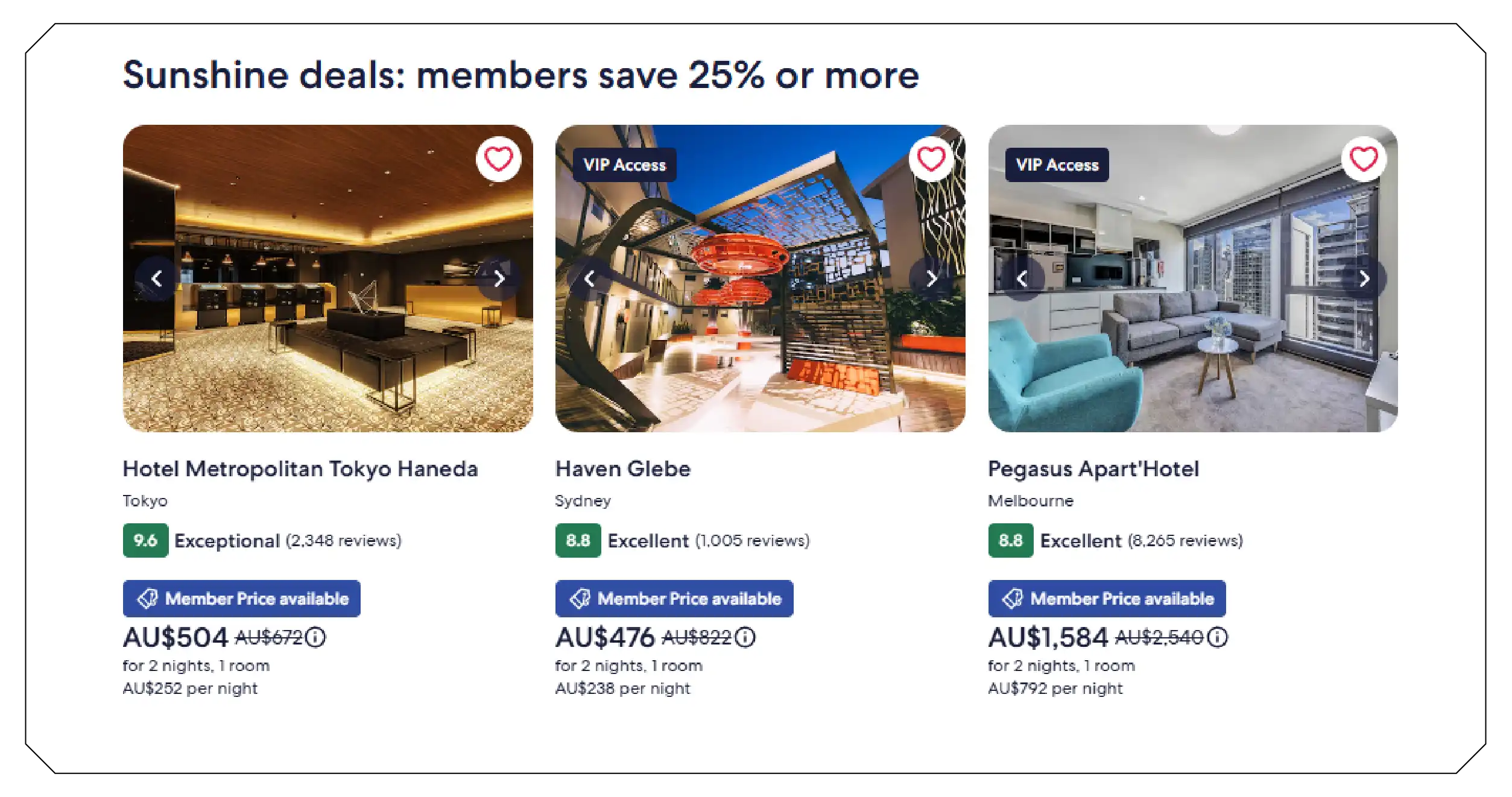
Manual price tracking is the traditional method of collecting hotel pricing information by visiting booking platforms, brand websites, and OTAs such as Booking.com or Expedia. Revenue managers or analysts typically log this information into spreadsheets and update it at regular intervals.
How Manual Price Tracking Works?
A team member manually searches for competitor hotels, checks room rates for different dates, notes discounts, and records the data. This process is often repeated daily or weekly depending on business requirements.
Advantages of Manual Price Tracking
Manual tracking offers a few notable benefits. It has a low initial cost since no specialized tools or integrations are required. Smaller hotels or independent properties may prefer this approach when they monitor only a handful of competitors. It also allows human judgment, enabling analysts to note qualitative factors such as promotions, room descriptions, or bundled offers.
Disadvantages of Manual Price Tracking
Despite its simplicity, manual tracking is highly time-consuming and prone to human error. Data quickly becomes outdated, especially during peak seasons when prices change multiple times a day. Scaling this approach across cities, room types, and channels is nearly impossible. These limitations often result in delayed decisions, lost revenue opportunities, and inaccurate pricing strategies.
What Is a Hotel Data API?
A Hotel Data API is an automated solution that programmatically collects hotel pricing, availability, room types, and competitor data from multiple sources in real time. These APIs fetch large volumes of structured data directly into dashboards, pricing engines, or revenue management systems.
Hotels and travel businesses increasingly rely on Hotel Data Scraping Services to access clean, consistent, and continuously updated pricing intelligence without manual effort.
How Hotel Data APIs Work?
Hotel Data APIs connect directly to booking platforms, hotel websites, and travel aggregators using automated crawlers or integrations. They collect pricing data across dates, locations, room categories, and occupancy levels. The data is then standardized and delivered in formats compatible with analytics and BI tools.
This automation enables frequent updates—hourly or even real-time—ensuring that pricing strategies are always based on the latest market movements.
Advantages of Using Hotel Data APIs
One of the biggest advantages of Hotel Data APIs is speed and accuracy. Pricing data is updated continuously, reducing the risk of stale or incorrect information. Businesses gain access to large-scale datasets across multiple cities, competitors, and platforms simultaneously.
Another major benefit is advanced analytics. With access to structured datasets, hotels can apply machine learning models, demand forecasting, and dynamic pricing rules. This transforms raw pricing data into actionable Hotel Data Intelligence, empowering smarter and faster decisions.
APIs also significantly reduce operational costs in the long run. By eliminating repetitive manual work, teams can focus on strategy rather than data collection.
Disadvantages of Hotel Data APIs
Despite their advantages, Hotel Data APIs come with certain challenges. Initial setup costs and subscription fees may be higher than manual tracking, which can be a concern for very small properties. Technical expertise is often required to integrate APIs with internal systems or dashboards.
Additionally, data quality depends on the reliability of the provider. Poorly maintained APIs can lead to missing or inconsistent data, making it essential to work with experienced providers.
Comparing Accuracy and Timeliness
When it comes to accuracy, APIs clearly outperform manual tracking. Manual processes often capture prices at a single moment in time, missing intraday fluctuations. In contrast, APIs support Automated hotel price monitoring, ensuring pricing strategies adapt instantly to market changes.
This difference is particularly critical during high-demand periods such as festivals, holidays, or major events, where prices can shift dramatically within hours.
Scalability: Manual vs. API-Based Tracking
Scalability is where manual tracking struggles the most. Monitoring more than 10–15 competitors across multiple channels quickly becomes unmanageable. Expanding to new cities or markets requires additional manpower and time.
Hotel Data APIs, on the other hand, scale effortlessly. Whether tracking 50 hotels or 50,000, APIs deliver consistent performance. This makes them ideal for OTAs, hotel chains, revenue intelligence platforms, and travel analytics companies using a Travel Scraping API to power large-scale insights.
Cost Comparison Over Time
While manual tracking appears cheaper initially, hidden costs accumulate over time. Employee hours, data cleaning, error correction, and missed pricing opportunities all contribute to higher long-term expenses.
APIs involve upfront and ongoing costs, but the ROI is often significantly higher. Faster reactions to competitor pricing, improved occupancy rates, and optimized ADRs (Average Daily Rates) quickly offset the investment.
When Manual Price Tracking Still Makes Sense?
Manual tracking may still be useful for very small hotels with limited competition and static pricing. It can also support short-term research projects or validation checks where automation is unnecessary.
However, even in these cases, businesses must recognize the limitations to Scrape Manual hotel Price Tracking, particularly as markets become more dynamic and data-driven.
Strategic Use Cases for Hotel Data APIs
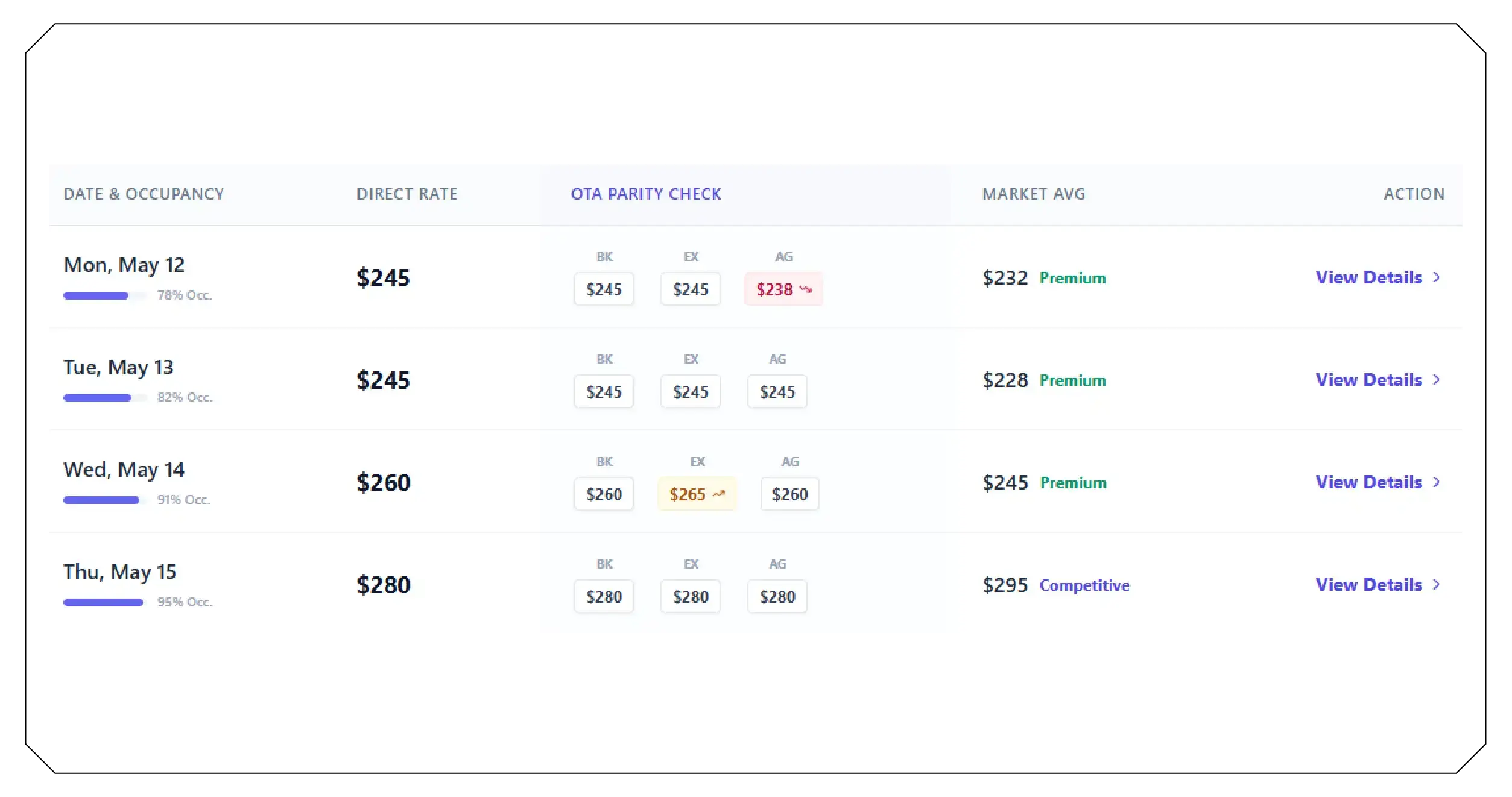
Hotel Data APIs are widely used for competitor benchmarking, revenue optimization, demand forecasting, and market intelligence. They enable hotels to monitor parity issues across OTAs, identify underpriced inventory, and respond proactively to market shifts.
For enterprise users, APIs play a crucial role in pricing automation tools and dynamic rate engines, enabling smarter pricing at scale through continuous hotel pricing API comparison across platforms.
How Travel Scrape Can Help You?
1. Real-Time Competitive Price Monitoring
Our data scraping services continuously track hotel prices across OTAs, brand websites, and booking platforms. This enables you to monitor competitor rate changes in real time and react instantly with smarter pricing decisions, helping you stay competitive in fast-moving markets.
2. Scalable and Accurate Data Collection
We automate large-scale hotel data collection across multiple cities, room types, and dates with high accuracy. Unlike manual tracking, our solutions eliminate human errors and deliver consistent, structured datasets that scale effortlessly as your business grows.
3. Actionable Pricing & Market Intelligence
By transforming raw scraped data into clean, usable formats, we help you uncover trends, demand patterns, and pricing gaps. This supports better forecasting, dynamic pricing strategies, and data-driven decision-making across revenue and marketing teams.
4. Custom Integration with Your Systems
Our scraping solutions are designed to integrate seamlessly with your existing dashboards, BI tools, or revenue management systems. You receive data in the format you need—API, JSON, CSV, or database-ready—without disrupting your workflows.
5. Time and Cost Efficiency
By automating repetitive data collection tasks, our services significantly reduce operational effort and costs. Your teams can focus on strategy and optimization while we handle reliable, compliant, and continuous data extraction behind the scenes.
Conclusion
In the evolving hospitality industry, relying solely on manual price tracking is no longer sustainable for most businesses. While manual methods offer simplicity and low upfront costs, they fall short in accuracy, scalability, and speed.
Hotel Data APIs provide real-time insights, automation, and advanced analytics that empower smarter pricing decisions. For hotels and travel businesses aiming to remain competitive, the ability to extract real-time hotel pricing data API solutions is becoming essential. As competition intensifies, more hotels are choosing to hotels track competitor prices using APIs rather than spreadsheets, leveraging Hotel Rate Data Scraping to drive profitability and long-term growth.
Ultimately, while manual tracking may still have limited use cases, Hotel Data APIs are clearly the better choice for modern, data-driven hotel pricing strategies.
Ready to elevate your travel business with cutting-edge data insights? Scrape Aggregated Flight Fares to identify competitive rates and optimize your revenue strategies efficiently. Discover emerging opportunities with tools to Extract Travel Website Data, leveraging comprehensive data to forecast market shifts and enhance your service offerings. Real-Time Travel App Data Scraping Services helps stay ahead of competitors, gaining instant insights into bookings, promotions, and customer behavior across multiple platforms. Get in touch with Travel Scrape today to explore how our end-to-end data solutions can uncover new revenue streams, enhance your offerings, and strengthen your competitive edge in the travel market.
Unlock the Full Report
Enter your details to access premium pricing intelligence insights