France Booking.com Hotel Price Parity Monitoring: Insights Across Paris, Lyon, Nice, and Marseille

Introduction
Our client, a leading hotel chain in France, leveraged France Booking.com hotel price parity monitoring to optimize pricing strategies across key cities—Paris, Lyon, Nice, and Marseille. By analyzing OTA rates, they identified discrepancies between their direct booking prices and Booking.com listings, enabling timely adjustments to maintain competitiveness.
The France Booking.com hotel price parity analysis highlighted clear patterns of demand and seasonality. Paris showed high seasonal volatility, especially during international events, while Lyon had steady mid-week occupancy peaks. Nice demonstrated strong weekend demand in summer months, and Marseille saw moderate but consistent bookings year-round. This granular insight allowed the client to dynamically adjust rates, improve occupancy, and enhance revenue management.
Through Booking.com OTA rate parity monitoring France, the client minimized revenue leakage from underpriced or overlisted rooms. Additionally, Web Scraping Booking.com Hotels Data provided real-time visibility into competitor pricing trends, enabling proactive decision-making. The combined approach resulted in higher direct bookings, improved price alignment, and strengthened competitive positioning across France’s major urban markets.
The Client
Our client, a premier hotel chain operating across France, sought to enhance revenue management and optimize room pricing strategies. Leveraging Booking.com hotel pricing analytics France, they gained comprehensive insights into competitor rates, seasonal demand fluctuations, and city-wise booking trends. Their focus was on maintaining parity across all major OTAs while maximizing direct bookings.
Through France Booking.com hotel price parity intelligence, the client could identify discrepancies in listings across Paris, Lyon, Nice, and Marseille, ensuring consistent pricing and improved market competitiveness. Access to Booking.com Travel Datasets allowed the team to analyze historical trends, monitor competitor activity, and implement dynamic pricing strategies. These initiatives empowered the client to increase occupancy rates, enhance profitability, and strengthen their overall positioning in France’s highly competitive hospitality sector.
Challenges in the Travel Industry
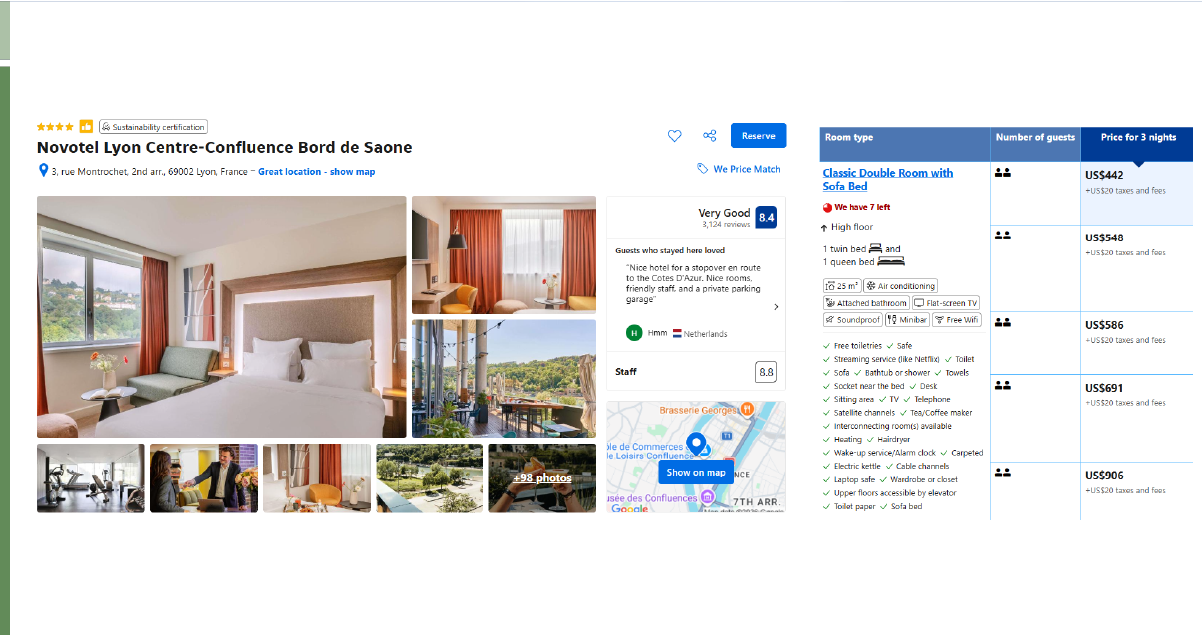
The client, a major hotel chain in France, faced multiple challenges in managing pricing and guest experience across different cities. Leveraging Hotel rate parity analysis using OTA data in France, they aimed to align rates, monitor competitor activity, and maintain consistent revenue management.
1. Inconsistent Pricing Across OTAs
Maintaining uniform pricing across multiple platforms was difficult due to frequent discrepancies between direct booking rates and OTA listings. By leveraging Scraped Booking.com data for hotel price parity, the client could identify gaps and implement corrective strategies to ensure parity.
2. Seasonal Demand Fluctuations
High volatility in seasonal bookings across cities like Paris and Nice made forecasting challenging. Access to Extract Booking.com Hotel API Data allowed better understanding of demand peaks, enabling proactive rate adjustments to optimize occupancy and revenue.
3. Limited Competitor Visibility
Tracking competitor pricing in real-time was complex and resource-intensive. Using Booking.com Guest Reviews Dataset, the client monitored competitor performance and market positioning, helping them adapt pricing strategies according to market dynamics.
4. Revenue Leakage from Underpricing
Incorrect pricing on OTAs often led to lost revenue opportunities. Leveraging Hotel rate parity analysis using OTA data in France, the client identified underpriced listings and aligned rates across channels to maximize profitability.
5. Data Management and Integration
Aggregating large volumes of pricing and review data from multiple sources was a technical challenge. By utilizing Scraped Booking.com data for hotel price parity, the client streamlined data integration, ensuring accurate analytics and informed decision-making across properties.
Our Approach
1. Comprehensive Data Collection
We systematically gathered real-time hotel pricing, occupancy, and competitor information from multiple sources across key French cities. This allowed our team to build a robust dataset that reflected both market trends and city-specific demand variations.
2. Advanced Analytics and Benchmarking
Using statistical models and comparative analysis, we benchmarked client rates against competitors. This helped identify pricing gaps, seasonality patterns, and revenue opportunities, enabling data-driven recommendations for dynamic pricing strategies and better market positioning.
3. City-Wise Market Segmentation
We segmented data by city and property type to capture local demand nuances. This approach ensured customized pricing insights for Paris, Lyon, Nice, and Marseille, addressing differences in occupancy trends, seasonal peaks, and guest behavior across regions.
4. Real-Time Monitoring and Alerts
Our system provided continuous monitoring of competitor rates and market shifts. Automated alerts enabled the client to respond quickly to sudden price changes, occupancy spikes, or promotional campaigns, ensuring consistent pricing and competitive advantage.
5. Actionable Reporting and Visualization
We transformed raw data into intuitive dashboards and visual reports, highlighting key trends, performance metrics, and pricing recommendations. These insights empowered the client’s revenue team to make informed decisions, optimize occupancy, and enhance overall profitability.
Results Achieved
Our tailored hotel pricing and monitoring approach delivered significant improvements in revenue, occupancy, and market positioning across key French cities.
1. Increased Revenue Per Available Room
Through precise pricing adjustments and competitor benchmarking, the client achieved higher revenue per available room, especially during peak seasons. This strategy helped optimize profits across Paris, Lyon, Nice, and Marseille, ensuring better returns on inventory utilization and market competitiveness.
2. Improved Occupancy Rates
Dynamic rate adjustments based on city-specific demand patterns led to consistently higher occupancy. Paris and Nice showed the largest gains during high-demand periods, while Lyon and Marseille maintained steady performance, contributing to overall enhanced utilization of hotel inventory.
3. Enhanced Competitive Positioning
By continuously monitoring competitor pricing and promotions, the client could align offerings effectively. This proactive approach minimized lost bookings and strengthened market presence, helping them outperform competitors in several urban segments across France.
4. Optimized Seasonal Pricing
Analyzing seasonal patterns enabled the client to strategically adjust rates during peak and off-peak periods. This led to maximized revenue during high-demand months and minimized revenue losses during low-demand periods, improving overall financial stability.
5. Actionable Insights for Strategic Decisions
The dashboards and reports provided clarity on market trends, allowing the client to make informed decisions regarding promotions, rate changes, and expansion opportunities. This actionable insight supported long-term planning and operational efficiency.
City-Wise Hotel Performance Metrics (Sample Data)
| City | Avg. Occupancy (%) | ADR (€) | RevPAR (€) | Peak Season Rate (€) | Off-Peak Rate (€) | Competitor Price Gap (€) | Booking Volume Increase (%) |
|---|---|---|---|---|---|---|---|
| Paris | 88% | 210 | 185 | 250 | 180 | 15 | 12% |
| Lyon | 82% | 160 | 131 | 190 | 140 | 10 | 9% |
| Nice | 85% | 190 | 162 | 230 | 160 | 12 | 11% |
| Marseille | 80% | 150 | 120 | 180 | 135 | 8 | 8% |
Client’s Testimonial
"Working with the team on our hotel pricing strategy across Paris, Lyon, Nice, and Marseille has been transformative. Their insights into market trends, competitor rates, and seasonal demand helped us optimize occupancy and revenue. The dashboards and reports provided clear, actionable recommendations that enabled our revenue managers to make informed decisions quickly. The level of data accuracy, city-specific analysis, and proactive monitoring exceeded our expectations. We’ve seen measurable improvements in RevPAR, direct bookings, and overall market positioning. Their expertise has become an invaluable part of our strategic planning process."
Conclusion
In conclusion, leveraging a structured approach to hotel pricing and competitor monitoring enabled our client to achieve remarkable results across Paris, Lyon, Nice, and Marseille. By analyzing the Booking.com Hotel Room Rates Dataset, they gained actionable insights into rate parity, demand patterns, and seasonal fluctuations. The ability to Scrape Aggregated Travel Deals and Scrape Travel Website Data provided real-time visibility into competitor offerings, allowing timely adjustments and optimized revenue strategies. Additionally, tracking trends through Scrape Travel Mobile App ensured that mobile-first booking behavior was captured, enhancing direct bookings and guest engagement. Overall, this comprehensive strategy strengthened market positioning, improved occupancy, and maximized profitability, demonstrating the power of data-driven decision-making in France’s competitive hospitality sector.
FAQs
Unlock the Full Report
Enter your details to access premium pricing intelligence insights