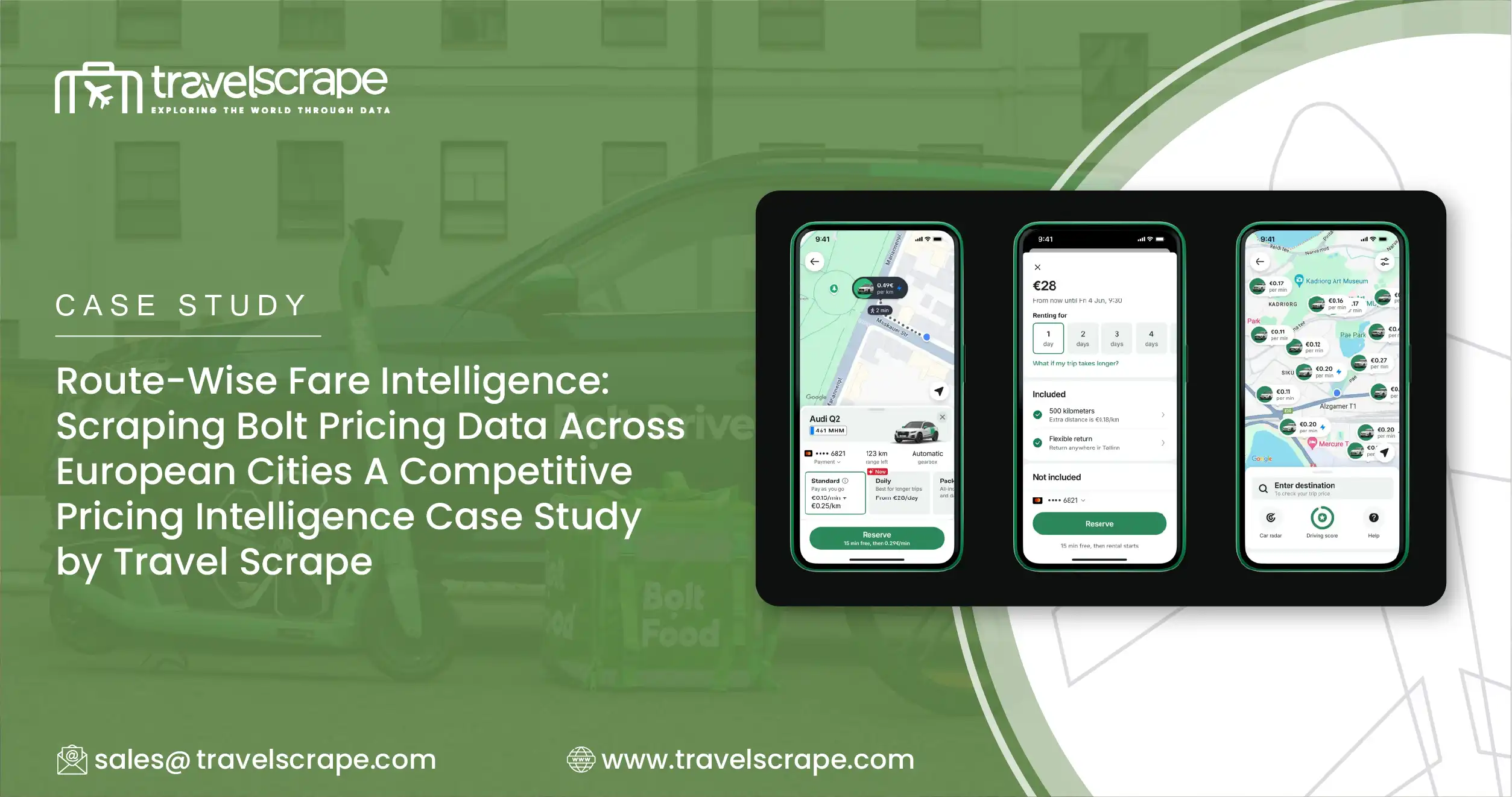
Route-Wise Fare Intelligence: Scraping Bolt Pricing Data Across European Cities A Competitive Pricing Intelligence Case Study by Travel Scrape
Introduction
This case study explains how Travel Scrape built route-wise fare intelligence by scraping Bolt pricing data across European cities, enabling a mobility startup to benchmark airport, CBD, and residential routes with normalized fare-per-kilometre analysis.
For mobility startups, pricing is not just an operational decision. It is a core part of brand positioning. Claiming to be a “low-cost alternative” is easy in marketing language, but investors, partners, and enterprise customers expect that claim to be supported by data.
This case study explains how Travel Scrape helped a European mobility startup benchmark Bolt against competitors across airport, CBD, and residential routes. By normalizing fares on a per-kilometre basis, the client gained clear evidence of Bolt’s pricing advantage and used it to support go-to-market strategy and expansion planning.
Business Challenge
The client was a fast-growing European mobility startup operating in multiple cities. Their strategic narrative was centred around one idea:
Offering reliable urban mobility at a lower cost than premium competitors.
However, as they prepared for a new funding round and geographic expansion, they faced a credibility gap.
Core Questions from Stakeholders
- Is Bolt actually cheaper across comparable routes, or only in selective cases?
- How does Bolt perform on high-visibility routes like airports and CBD corridors?
- Does lower pricing come with higher volatility or surge risk?
- Can pricing advantages be measured consistently across cities?
The client needed defensible, route-level pricing benchmarks, not anecdotal screenshots or marketing claims.
Why Route-Wise Benchmarking Was Critical
Travel Scrape identified early that city-level averages would not be sufficient.
In European cities:
- Airport routes often include fixed fees, tolls, and congestion premiums
- CBD travel is affected by traffic restrictions and peak congestion
- Residential routes behave very differently in terms of surge and availability
Comparing platforms without controlling for route type and distance would lead to misleading conclusions.
The solution required route normalization and fare-per-kilometre analysis.
Solution by Travel Scrape
Travel Scrape designed a route-wise fare benchmarking framework specifically for European urban mobility markets.
Instead of comparing random rides, the solution focused on standardized routes across cities and normalized pricing metrics.
Route Framework Design
Each city was mapped into three consistent mobility zones:
- Major Airport
- Central Business District (CBD)
- Residential Suburbs
Using these zones, Travel Scrape defined repeatable route categories:
- Airport → CBD
- CBD → Residential
- Residential → Residential
These routes were selected because they represent:
- High-volume commuter traffic
- Investor-visible use cases
- Cost-sensitive user journeys
Geographic Coverage
The benchmarking study covered major European mobility hubs, including:
- Berlin
- Paris
- Amsterdam
- Madrid
- Milan
- Vienna
- Lisbon
- Prague
This allowed the client to compare Western and Central European pricing dynamics using a single framework.
Data Collection Methodology
Travel Scrape implemented a structured data extraction pipeline focused on accuracy and comparability.
Fare Capture Process
- Multiple fare estimates collected daily
- Coverage across:
- Morning peak
- Midday
- Evening peak
- Late-night off-peak
- Both weekdays and weekends included
Key Data Attributes Captured
For each fare quote:
- City
- Route type
- Pickup zone
- Drop-off zone
- Distance (km)
- Estimated fare (€)
- Time slot
- Platform identifier
This enabled precise normalization and cross-platform comparison.
Distance Normalization and Fare-per-Km Logic
One of the most important steps in the analysis was distance normalization.
Instead of comparing total fares, Travel Scrape calculated:
Fare per kilometer (€ / km)
This removed distortions caused by:
- Slight route length differences
- City-specific road layouts
- Detours and congestion patterns
Fare-per-km became the core metric for benchmarking.
Sample Benchmark Table
Below is a simplified extract from the benchmarking dataset.
| City | Route | Fare per km (€) | Platform Position |
|---|---|---|---|
| Berlin | Airport → CBD | 1.25 | Lowest |
| Paris | Airport → CBD | 1.38 | Competitive |
| Amsterdam | CBD → Residential | 1.42 | Lowest |
| Madrid | Residential → Residential | 1.10 | Lowest |
| Milan | Airport → CBD | 1.46 | Competitive |
This table allowed the client to clearly demonstrate Bolt’s relative pricing position without subjective interpretation.
Analytical Framework Applied
Travel Scrape supported the client with a structured pricing intelligence model.
Key Metrics Calculated
- Average fare per km by route and city
- Price delta vs premium competitors
- Surge volatility index
- Route-level pricing consistency score
- City-wise competitive positioning
These metrics were designed to be investor-friendly and presentation-ready.
Key Insights Uncovered
1. Bolt Was Consistently Cheaper on Core Routes
Across the majority of cities and routes analyzed:
- Bolt priced 10–18% lower than premium competitors
- The gap was most pronounced on:
- Airport → CBD routes
- High-demand CBD corridors
This validated the client’s low-cost positioning with quantitative evidence.
2. Strong Price Advantage on Airport Transfers
Airport routes are highly visible and often used as reference points by users.
The analysis showed that:
- Bolt maintained a consistent price advantage on airport routes
- Fare-per-km remained lower even during peak hours
- Premium competitors showed sharper peak uplifts
This insight was especially valuable for investor discussions, as airport transfers are easy to understand and compare.
3. Minimal Surge Behavior on Residential Routes
One of the most reassuring findings was related to residential travel.
- Residential → residential routes showed minimal surge
- Fare-per-km remained stable across time slots
- Pricing predictability was higher than expected
This suggested that Bolt’s lower pricing was not driven by aggressive surge behavior elsewhere.
4. Competitive, Not Aggressive, CBD Pricing
In CBD routes:
- Bolt was often “competitive” rather than the absolute lowest
- Price differences were narrower due to congestion constraints
- However, volatility was still lower than premium competitors
This nuance helped the client present a balanced and credible narrative.
Business Impact
The benchmarking study delivered clear strategic value.
1. Supported Go-To-Market Pricing Strategy
The client used the findings to refine messaging:
- Positioned Bolt as a value-driven, not discount-only platform
- Highlighted predictable pricing rather than extreme undercutting
- Built confidence in sustainable pricing strategy
This improved resonance with enterprise partners and regulators.
2. Helped Justify “Value Positioning” to Investors
During investor discussions, the client used Travel Scrape’s data to:
- Show consistent price advantage across cities
- Demonstrate disciplined pricing behavior
- Support claims with normalized, route-wise metrics
This replaced anecdotal screenshots with defensible analytics.
3. Built Confidence in Expansion Planning
The city-wise benchmarks allowed leadership teams to:
- Identify cities where pricing advantage was strongest
- Prioritize expansion markets with favorable unit economics
- Avoid cities where premium competitors had structural advantages
Expansion decisions became data-backed rather than intuition-driven.
Why Travel Scrape
Travel Scrape specializes in travel and mobility data intelligence across global markets.
What differentiates Travel Scrape:
- Route-wise fare normalization
- Fare-per-km benchmarking expertise
- Multi-city and multi-platform coverage
- Investor-ready analytical outputs
- Clean, structured, and scalable datasets
Travel Scrape helps organizations turn complex mobility data into clear strategic signals.
Conclusion
In competitive mobility markets, pricing claims must be backed by evidence. City averages and isolated screenshots are no longer sufficient.
This case study shows how Travel Scrape transformed Bolt fare data into route-wise, normalized pricing intelligence, enabling a European mobility startup to validate its low-cost positioning, strengthen investor confidence, and plan expansion with clarity.
For mobility platforms competing on value, route-level benchmarking is not optional. It is a strategic requirement.
Unlock the Full Report
Enter your details to access premium pricing intelligence insights