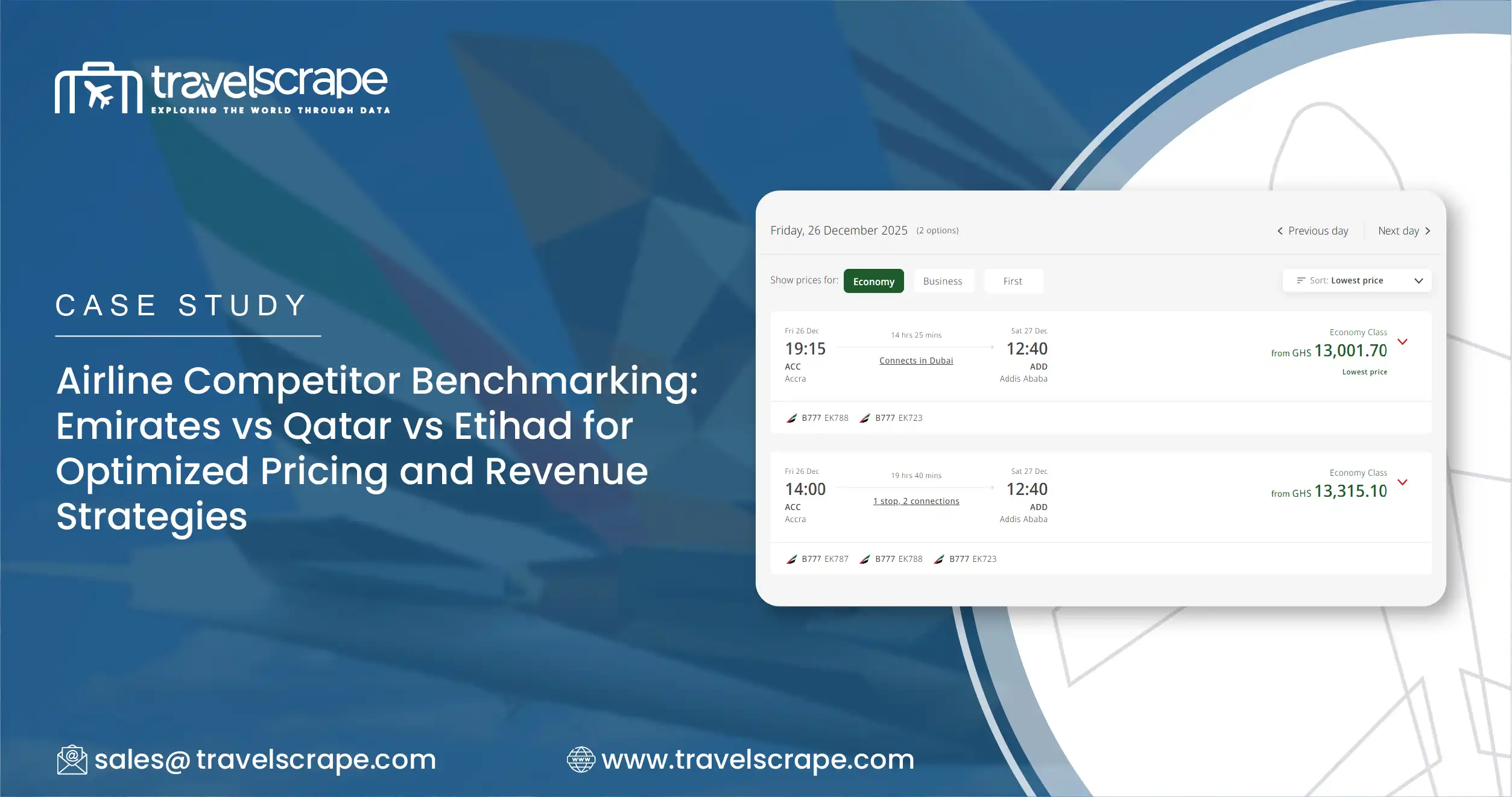
Airline Competitor Benchmarking: Emirates vs Qatar vs Etihad for Optimized Pricing and Revenue Strategies
Introduction
The client, a leading Middle Eastern airline, needed deeper visibility into how rival carriers priced routes, launched promotions, and adjusted fares across peak and off-peak travel seasons. By integrating Airline Competitor Benchmarking, they aimed to understand real-time market movements and strengthen their pricing strategy. However, the airline’s internal analytics team lacked a consistent, structured, and automated data pipeline to compare competitor fares at scale.
Through our advanced platform, we delivered a continuous stream of competitive airline intelligence, capturing dynamic fare shifts, seasonal adjustments, ancillary pricing, seat availability patterns, and route-specific fluctuations. This allowed the client to track how competitors reacted to holidays, weekends, and route demand.
With Emirates Flight Data Scraping Services, the client received structured datasets that aligned competitor decisions with traveler behavior. This intelligence provided clarity on fare positioning, promotional timing, and emerging pricing tactics. As a result, the airline optimized revenue models, strengthened predictive pricing, and significantly enhanced competitive performance across high-demand routes.
The Client
The client, a rapidly expanding international airline, sought stronger visibility into market dynamics to stay ahead of global competitors. Their internal team needed deeper insights into fare shifts, promotional strategies, and route-level competitiveness. By leveraging airline competitive market analysis, the brand aimed to align its pricing structure with evolving traveler expectations while maintaining profitability.
As the airline continued to scale operations across Europe, Asia, and the Middle East, understanding competitor behavior became essential. Through Qatar Airways Flight Data Scraping Services, they gained structured datasets that revealed competitor fare updates, seasonal adjustments, and market reactions in real time.
To support daily decision-making, Real time airline price monitoring helped the airline track fluctuating fares across multiple routes. This equipped them with accurate benchmarks, enabling quicker responses to market shifts.
Challenges in the Travel Industry
The client faced increasing pressure to understand competitor fare patterns and rapidly changing market dynamics. Their internal teams struggled to keep up with fluctuating airline pricing, regional promotional shifts, and route-level competition across multiple geographies. They required deeper visibility, automation, and reliable data intelligence.
- Difficulty Accessing Competitor Fare Comparisons
The client lacked automated tools for real-time insights, making competitor benchmarking slow and inconsistent. Manual processes limited accuracy and scale, creating challenges in responding to fast-changing fare movements. Integrating Emirates flight price extraction was essential for comprehensive competitive visibility across priority routes. - Limited Visibility Into Regional Pricing Strategies
Understanding competitor decisions across global hubs remained difficult. The airline struggled to track seasonal fare drops, loyalty-driven discounts, and tactical promotions. Implementing Qatar Airways fare intelligence became critical to discover pricing patterns influencing their international route strategies. - Inability to Track Frequent Pricing Fluctuations
The airline faced constant price volatility, making it challenging to remain competitive. They lacked continuous monitoring systems for daily and hourly changes. With Etihad airfare scraping, they required consistent data feeds to detect emerging competitor adjustments and respond effectively. - Fragmented Data Sources and Slow Analysis
Data came from multiple markets, requiring time-consuming consolidation. This slowed decision-making and affected yield management. Deploying Etihad Flight Data Scraping Services became necessary to unify structured datasets for accurate analysis across all competitive routes. - Insufficient Insights for Revenue Optimization
The client struggled to connect pricing trends to revenue outcomes. Without detailed analytics, detecting profitable opportunities was difficult. Leveraging Flight Price Data Intelligence allowed them to interpret fare patterns, monitor pricing pressure, and refine their pricing strategies with improved accuracy.
Our Approach
- End-to-End Data Mapping Strategy: We began by outlining every required data source, route, and competitive segment. This structured mapping allowed us to build a clear extraction blueprint, ensuring complete coverage of pricing, schedules, and market behaviors while maintaining accuracy and consistency across all target geographies.
- Automated Real-Time Data Pipelines: Our team deployed automated pipelines capable of capturing fare updates continuously. These pipelines ensured uninterrupted data flow, allowing the client to receive instant insights on competitive movements without manual intervention, reducing delays and improving overall decision-making speed across departments.
- Unified Data Normalization Framework: We standardized pricing structures, schedules, and route identifiers into a unified format. This normalization framework eliminated inconsistencies, supported smooth integration with internal systems, and allowed analysts to compare competitors seamlessly without confusion or data discrepancies slowing down their workflows.
- Custom Dashboards for Strategic Insights: We developed intuitive dashboards that transformed raw datasets into visual intelligence. These dashboards highlighted fare trends, competitor patterns, and anomalies, enabling leadership teams to quickly understand shifts, identify opportunities, and take timely strategic actions based on real-time insights.
- Continuous Monitoring and Optimization: Our approach included ongoing performance checks to enhance extraction speed, data accuracy, and reporting quality. We ensured the system evolved with market changes, providing the client long-term scalability, reliability, and high-value insights aligned with their growth strategy.
Results Achieved
Our strategic enhancements delivered measurable improvements, empowering the client with stronger competitive visibility, faster decisions, and more stable revenue performance.
- Significant Improvement in Pricing Accuracy: The refined data pipelines delivered highly accurate fare insights, reducing guesswork and enabling the client to align prices confidently with market movements. This accuracy supported better forecasting, minimized revenue leakage, and helped maintain competitive positioning across multiple international routes consistently.
- Faster Response to Market Fluctuations: With real-time monitoring established, the client could respond instantly to competitor price shifts. This agility ensured they never lagged behind market movements and allowed internal teams to run rapid tactical adjustments that strengthened both competitiveness and customer appeal in dynamic markets.
- Enhanced Visibility Across Route Networks: The unified datasets revealed clear patterns across domestic and international routes. This visibility enabled the client to uncover hidden opportunities, understand route-level profitability, and prioritize markets with the highest strategic value, helping leadership make decisions supported by reliable and actionable intelligence.
- Streamlined Internal Decision-Making Processes: The centralized dashboards eliminated manual reporting delays, empowering analysts and revenue teams with instant access to structured insights. This reduction in operational effort allowed teams to focus on planning, forecasting, and implementing smarter strategies rather than managing fragmented data workflows daily.
- Measurable Growth in Revenue Optimization Efficiency: With improved clarity and consistent insights, the client achieved more precise fare planning and better promotional timing. These optimized strategies directly contributed to improved revenue outcomes, more stable margins, and sustained competitiveness across key markets throughout fluctuating travel seasons.
Sample Scraped Data Table
| Route | Date | Competitor Airline | Competitor Fare | Client Fare | Price Difference |
|---|---|---|---|---|---|
| DXB → LHR | 12/08/2025 | Emirates | $624 | $610 | -$14 |
| DOH → JFK | 12/08/2025 | Qatar Airways | $899 | $920 | +$21 |
| AUH → SIN | 12/08/2025 | Etihad Airways | $455 | $448 | -$7 |
| DXB → SYD | 12/08/2025 | Emirates | $1,120 | $1,099 | -$21 |
Client’s Testimonial
"Working with this team has transformed our competitive pricing strategy in ways we didn’t anticipate. Their ability to deliver precise, timely, and structured airfare insights helped us make confident decisions and stay ahead in a highly volatile market. The clarity of their reports, combined with their ongoing support, created a level of transparency we had never experienced before. Thanks to their expertise, our revenue and pricing teams now operate with far greater accuracy and agility."
Conclusion
Leveraging structured airfare data has become a game-changer for airlines seeking to maintain a competitive edge in dynamic markets. By utilizing a Global Flight Price Trends Dataset, businesses can uncover patterns, monitor competitor behavior, and optimize pricing strategies across multiple routes. Our solutions also enable companies to Scrape Aggregated Travel Deals, ensuring they stay updated with the latest promotions and market offerings.
Additionally, the ability to Scrape Travel Website Data and extract critical information from booking platforms allows airlines to streamline decision-making and improve operational efficiency. With tools that can Scrape Travel Mobile App data, clients gain access to real-time insights on fare fluctuations and customer preferences, empowering them to enhance revenue, forecast trends accurately, and deliver superior travel experiences.
FAQs
Unlock the Full Report
Enter your details to access premium pricing intelligence insights